
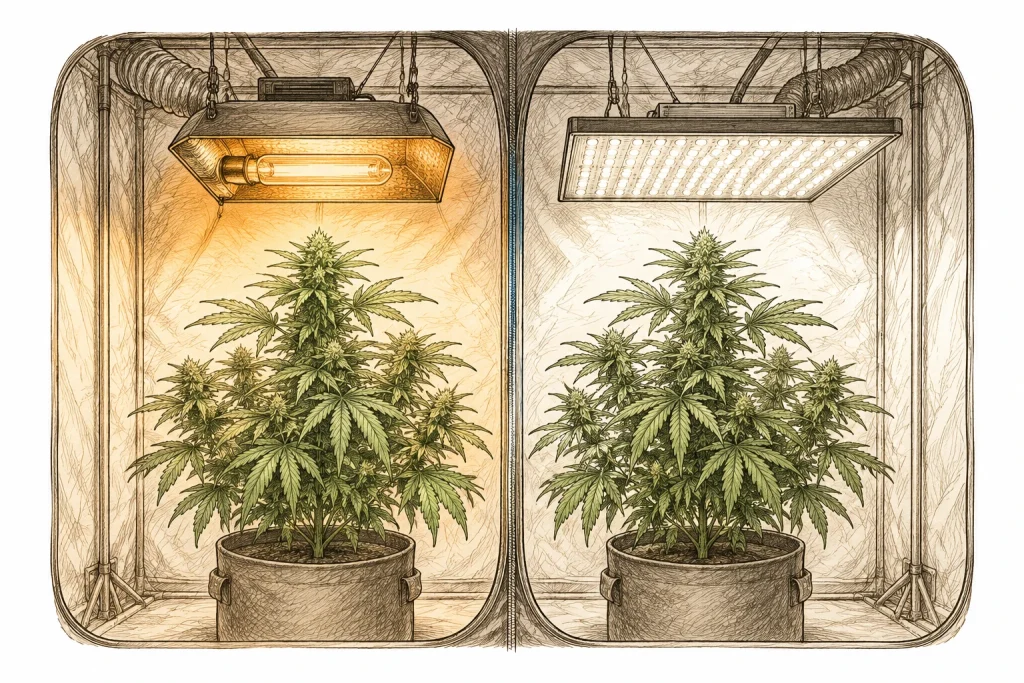
Planning your first grow room (you’ll find a complete walkthrough in the article Setting Up a Grow Tent (German)) or looking to upgrade your lighting? Sooner or later, you’ll face the same question: LED vs HPS for growing cannabis, which one is the better pick? Both technologies have their strengths and weaknesses. The right choice depends a lot on your setup, your budget and your goals. In this article, we compare both systems honestly and with real-world grows in mind, so you know exactly what you’re signing up for. For more diagnosis tips and help with grow problems, check out the Plant Diagnosis overview on PlantClue.
LED vs HPS Cannabis Grow: The Basics of Both Technologies
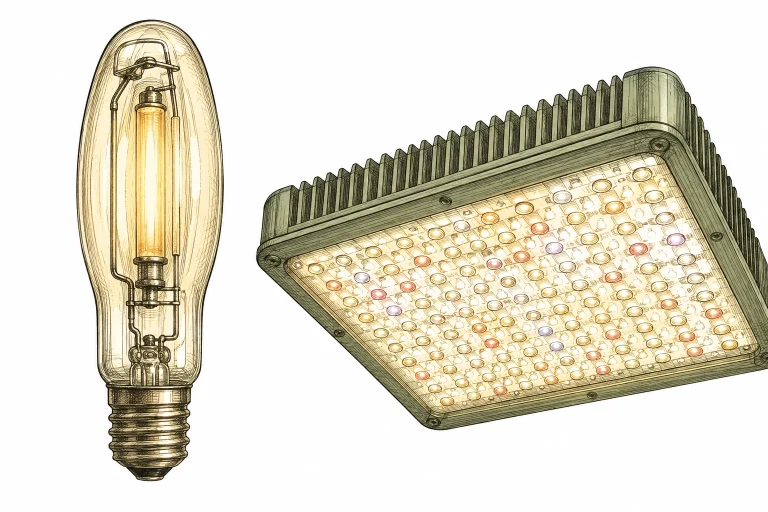
HPS stands for high pressure sodium. For decades, this technology has been the standard for commercial and serious hobby cannabis grows. An HPS lamp puts out intense, orange-yellow light with a spectrum that works especially well in the flowering stage. Plenty of experienced growers still swear by HPS because the results are reliable and the tech is proven.
LED stands for light emitting diode. Today’s grow LEDs aren’t cheap hardware-store light strips anymore. They’re sophisticated full-spectrum fixtures that can mimic sunlight very closely. The technology has come a long way in the last five years. Quality LEDs from brands like Spider Farmer, Mars Hydro, Gavita or Swiss manufacturer F.O.G. can easily keep up with HPS today, and in many cases they even outperform it.
- HPS: proven technology, low upfront cost, strong light output
- LED: modern spectrum, lower power draw, less heat
- Both systems are used by professional growers
- The right choice depends on your space, budget and experience
Power Consumption and Running Costs Side by Side
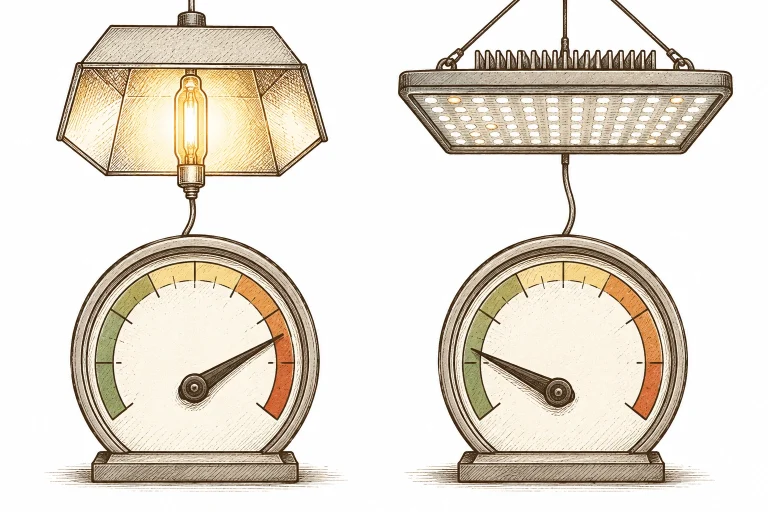
On power consumption, the verdict is clear: a 600 W HPS lamp actually pulls around 660 W from the wall once you factor in the ballast and accessories. A comparable LED often gets by on 300 to 400 W while delivering similar or even higher light intensity, measured as PPFD (German) (photosynthetic photon flux density). With 18 hours of light per day in the vegetative stage, that adds up to a big difference on your monthly electric bill. At around $0.17 per kWh, a good LED can save you roughly $20 to $35 per light per month compared to HPS, and even more if your rates are higher.
In the long run, a quality LED usually pays for itself within two to three harvests, despite the higher upfront price. HPS bulbs need to be replaced regularly because their light output drops noticeably after 10,000 to 15,000 hours of use. LED diodes, on the other hand, often last 50,000 hours or longer. So if you’re planning for the long haul, LED tends to come out cheaper overall.
- A 600 W HPS actually draws about 660 W including the ballast
- A comparable LED gets by on 300–400 W
- LED uses about 40–50% less power than HPS
- LED diodes last up to 50,000 hours
- HPS bulbs get noticeably weaker after 10,000–15,000 h
- An LED pays for itself after 2–3 harvests with regular use
Heat: Why HPS Makes Your Grow More Complicated
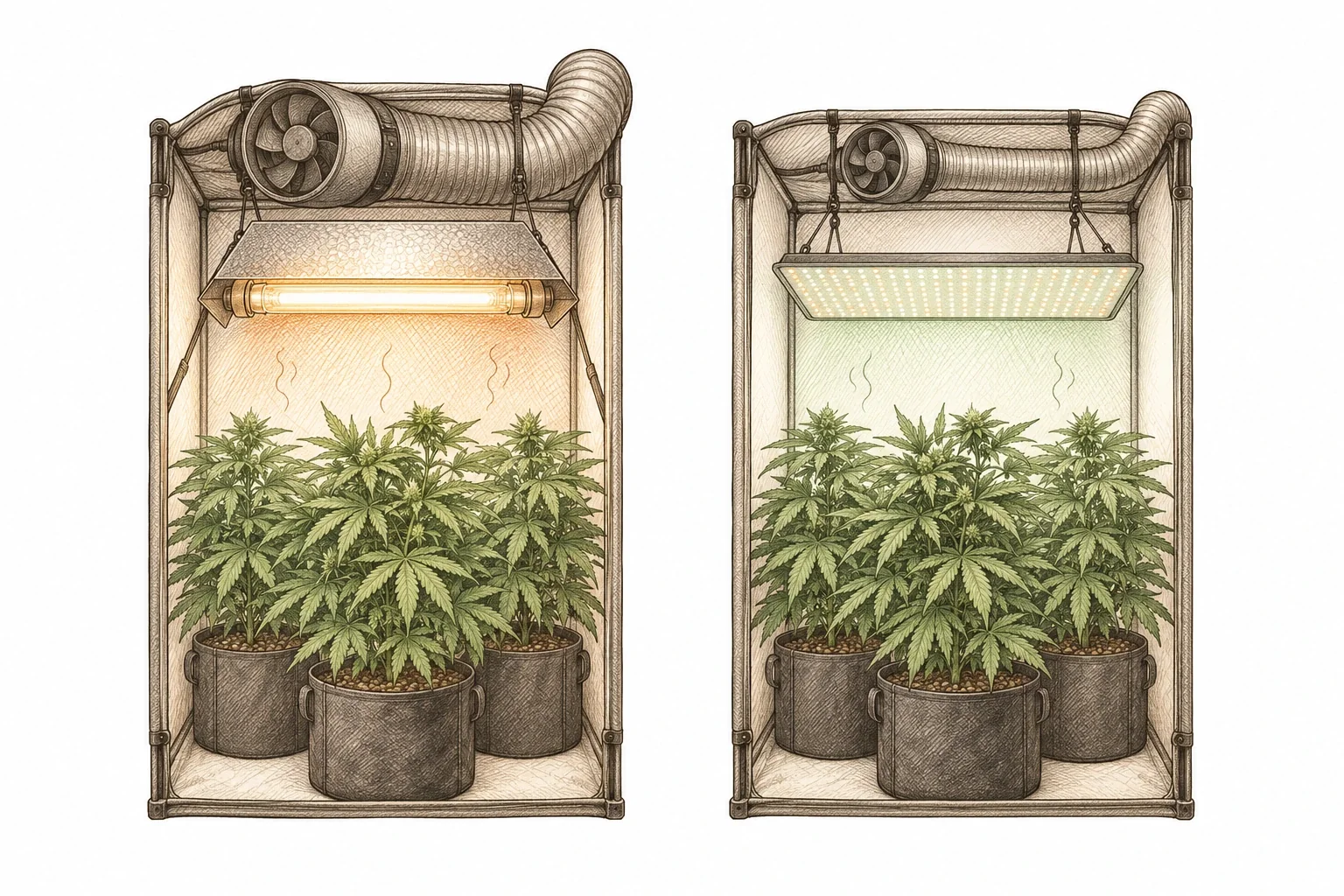
One major downside of HPS is the extreme heat. A 600 W HPS lamp puts out so much radiant heat that a small grow without active cooling can quickly hit 95 °F (35 °C) or more in summer. Heat stress in cannabis can cause curling leaves and slower growth, and it can even ruin your harvest. So you don’t just need the lamp. You also need a powerful AC unit, or at least strong ventilation, which means more electricity and more cost.
LEDs give off much less radiant heat. They still produce some heat, but it’s usually carried away by heat sinks or built-in fans without driving up the room temperature as much. In summer, that can be the difference between a thriving grow and a total disaster. In winter, though, the heat from an HPS can actually help keep your space warm. So this point depends a lot on the season.
- HPS throws off a lot of radiant heat right into the canopy
- Temps above 82 °F (28 °C) can cause heat stress in cannabis
- LEDs put out less direct heat; most of it leaves through the heat sinks
- In winter, an HPS can double as a heater
- LED grows need less cooling in summer
Light Spectrum and Plant Development: What Does Cannabis Really Need?
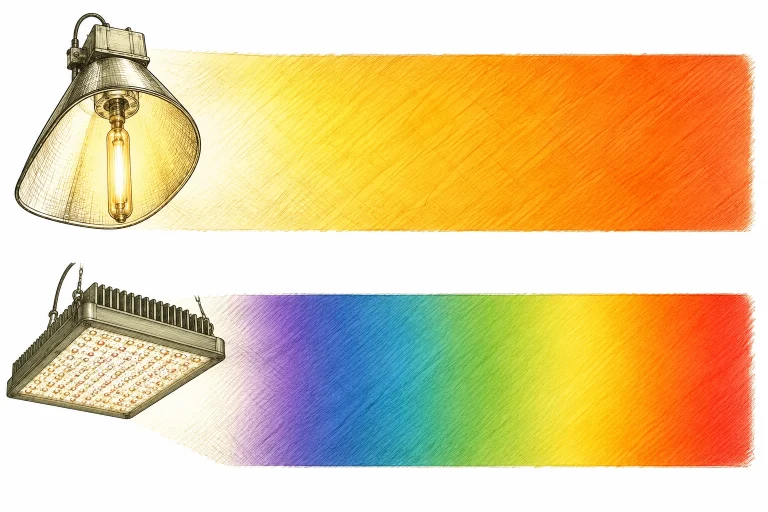
Cannabis needs different light spectra at different growth stages. During the vegetative stage (veg), plants benefit from more blue light (400–500 nm), which promotes compact, healthy growth. In the flowering stage, red light (600–700 nm) matters most for bud development. Modern full-spectrum LEDs cover the whole range, from UV through blue, green and red all the way to infrared. Some models even let you dim them or switch between veg and bloom modes via an app.
HPS delivers a very strong red spectrum that’s excellent for flowering. That’s why many growers run MH (metal halide) in veg and switch to HPS for flowering – which means two separate lamps. An LED handles both stages in one fixture, cutting down on hassle and upfront cost. Good to know: a balanced light spectrum also helps you read deficiencies and nutrient problems correctly. Under orange HPS light, yellow leaves and other symptoms can be harder to spot than under white LED light.
- Cannabis needs blue (400–500 nm) during veg
- Red (600–700 nm) drives bud development
- Full-spectrum LEDs cover all the wavelengths that matter
- HPS is great for flowering, weaker in veg
- Running MH + HPS is pricey and a hassle
- Plant symptoms are easier to spot under white LED light
LED vs HPS Cannabis Grow: Yield and Quality Compared
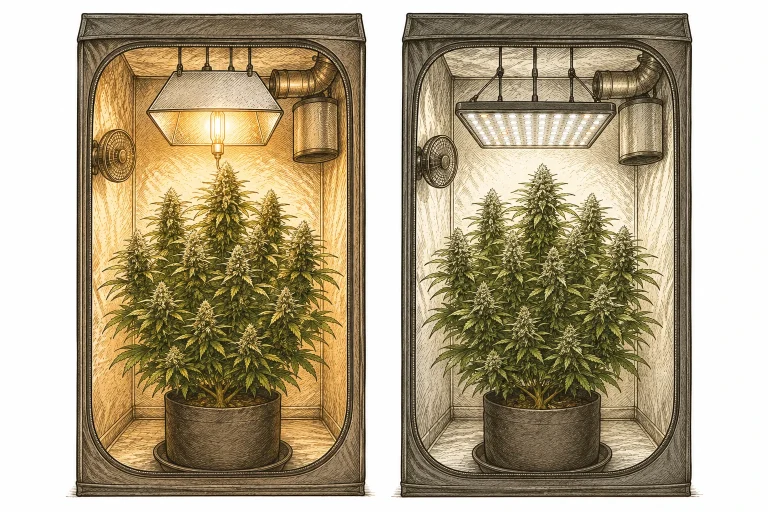
The big question for most growers: which light gives you more yield and better quality? The honest answer: at the same PPFD (photosynthetic photon flux density), the difference in dry weight is minimal. What counts isn’t the type of lamp itself, but how much usable light actually reaches your plants. A quality 500-watt LED can easily keep up with a 600-watt HPS – or even beat it. A scientific comparison study on greenhouse crops backs this up: the yield difference between LED and HPS depends more on light spectrum and duration of use than on raw wattage — blanket claims like “LED is always better” don’t hold up to the research.
When it comes to quality, LED grows often show surprising advantages: with less heat stress, plants can grow more relaxed and may develop higher terpene and cannabinoid levels. On top of that, LEDs often make it easier to control the distance between light and canopy, which leads to more even coverage. Always keep an eye on the right hanging height – even an LED can cause light burn if it’s too close. Check your plants for symptoms of cannabis light burn.
- Same PPFD = comparable yield with both technologies
- A quality LED can out-yield a 600 W HPS
- Less heat stress supports terpene and cannabinoid production
- LEDs give you better control over hanging height
- Cheap, low-quality LEDs often perform worse than a good HPS
Upfront Cost and Getting Started: What Does Each System Cost You?
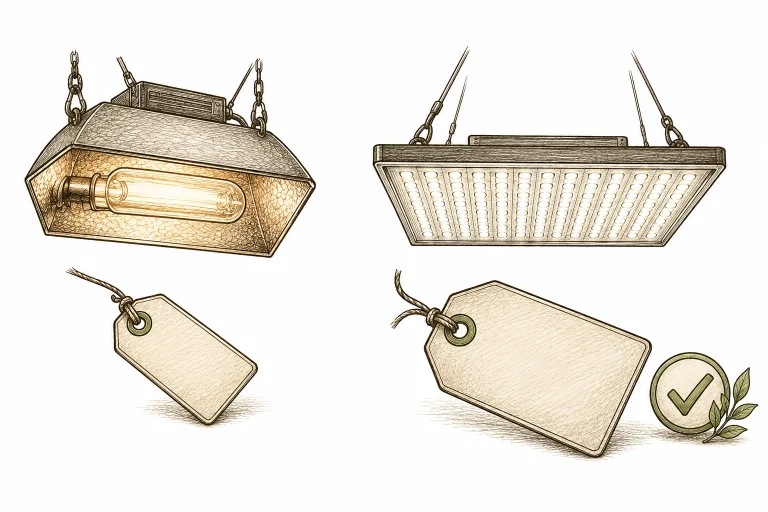
On upfront cost, HPS has a clear edge: a complete 600-watt HPS kit with ballast and reflector can be had for roughly $90 to $170. An LED with comparable output runs anywhere from about $220 to $650, depending on brand and quality. So if you’re just starting out on a tight budget, HPS can be the smarter entry point – especially if you only plan to run one or two grows.
If you’re thinking long term, add up your total costs over two to three years. Electricity costs, replacement bulbs for HPS, cooling and possible yield losses from heat stress all belong in that math. Once you include them, the picture shifts clearly in favor of LED. Our tip: never buy the cheapest LED on the market. Low-quality diodes often don’t deliver the advertised spectrum, and PPFD numbers are often wildly inflated. Go with brands that publish verified measurements and offer a solid warranty. We compare good models for 2×2 ft to 4×4 ft tents in our LED grow light comparison.
- 600W HPS kits start at roughly $90–$170
- A quality LED runs about $220–$650
- HPS is cheaper to start, LED is cheaper in the long run
- Cheap LEDs: PPFD claims are often exaggerated
- Our advice: stick with established brands that publish test reports
LED vs HPS for Growing Cannabis: Which System Is Right for You?
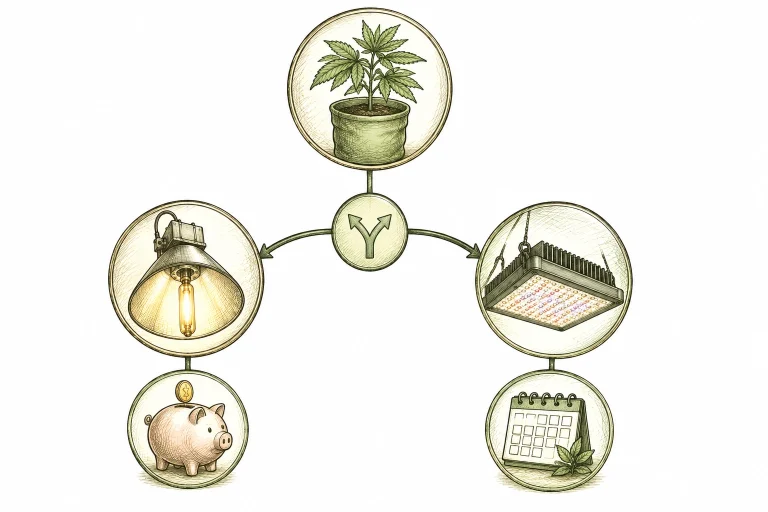
HPS is a great fit if you’re starting out on a small budget, already have good ventilation and climate control, and like proven technology. If you grow in a cool room or during winter, the extra heat from HPS can even work in your favor. Many experienced growers only switch to LED once their HPS gear reaches the end of its life.
LED is the better choice if you’re planning long term, want to save on power, grow in a warm room or during summer, or want the best possible control over the light spectrum. If plant health is your top priority and you want to avoid frequent deficiencies, we recommend switching to a quality full-spectrum LED. Keep in mind: even the best light won’t help if your pH is off. Check the pH of your nutrient solution or growing medium regularly so your plants can actually take up nutrients. And to set your grow up for success from day one, take a look at our beginner’s guide to indoor growing.
- HPS: ideal for beginners, cool rooms, small budgets
- LED: ideal for long-term growers, warm rooms, a focus on quality
- HPS heat can double as a heater in winter
- LED gives you more control over spectrum and light intensity
- Both systems work – the quality of the product makes the difference
Switching from HPS to LED: What to Watch Out For
When you switch from HPS to LED, you’re not just swapping a light – you’re changing the microclimate in your tent. HPS throws a lot of infrared heat onto your plants, so leaves often run 4–7 °F (2–4 °C) warmer than the room air. Under LED, leaf temperature tends to sit slightly below room temperature, because the light gives off very little infrared. Manufacturer resources such as the F.O.G. catalog describe it the same way. That leads to four common pitfalls:
- Lower water needs: Cooler leaves transpire less, so your plants drink more slowly. That’s why overwatering is a classic mistake after the switch. Water more sparingly at first and let the growing medium dry out. Learn more in our guide Overwatered cannabis: what to do.
- A slightly warmer room: Since the light heats your leaves less, a slightly higher room temperature can make sense. F.O.G. suggests 81 °F (27 °C) during the day and 70 °F (21 °C) at night as a guideline. To see how temperature and humidity work together, check out our guides on temperature and humidity.
- Higher nutrient needs with powerful LEDs: A strong LED often delivers a lot more light energy than your old HPS. Your plants grow faster and need more nutrients. Raise your feeding in small steps (F.O.G. suggests about 100 ppm (0.2 mS/cm) at a time) instead of jumping up all at once – otherwise you risk nutrient burn.
- Spotting light stress: Dry, brown leaf edges or leaves that fade from dark green to light green to yellow can point to too much light. If more nutrients don’t fix yellow leaves, the light intensity is often too high. Dim your light or raise it higher, and ideally measure intensity with a PPFD meter (measuring PPFD for cannabis).
These are guidelines, not hard rules. Every LED puts out light differently, so make changes gradually and watch your plants closely.
Supplemental UVB Light: What the Research Shows
Researchers are studying UVB light against powdery mildew as an add-on to your main grow light, not a replacement for it. In other crops, the evidence is solid. Researchers in Norway cut powdery mildew on greenhouse roses by more than 90 % with short daily UVB doses lasting from a few minutes up to about an hour (Suthaparan et al. 2012). On strawberries and rosemary, the reduction reached 90 to 99 % when UVB was applied in short doses at night (Suthaparan et al. 2016). The UVB acts directly on the fungus, not through the plant. A 2021 review article confirms the positive effect on disease resistance across many plant species. It also stresses that there’s no consensus on the best way to use it: light source, dose, time of day and duration all have a big impact on the results.
For cannabis, the evidence is thin. The powdery mildew data we found comes from two student theses commissioned by the Swiss LED manufacturer F.O.G. – Future of Grow, based in Aigle. A master’s thesis from Bern University of Applied Sciences (BFH/HAFL) by André Wêndabo Kientega, supervised by Dr. Fabio Mascher, tested powdery mildew on greenhouse cucumbers. With UVB alone, 84.6 % of the leaves stayed healthy. That was statistically no different from the sulfur comparison group (96.3 %). UVB combined with half the amount of sulfur reached 100 % healthy leaves. An earlier bachelor’s thesis at HEPIA Geneva (2023, same author), which lists F.O.G. as a research partner, tested UVB on strawberries and cannabis. On cannabis, 90 % of the plants stayed free of powdery mildew (statistically no different from the comparison product Armicarb), and 80 % of the plants showed no spider mites at the shoot tips. Both theses were done under university supervision, but they aren’t peer-reviewed and they aren’t independent research. The exact dosing is an F.O.G. trade secret, so they don’t give you a DIY recipe.
Be careful with promises about yield and potency. In an independent study in Frontiers in Plant Science (2021), two cannabis strains got 3.5 hours of UVB every day for 60 days during the flowering stage. Yield and cannabinoid content didn’t go up. Terpene content dropped by 24 to 41 %, and the plants showed stress such as leaf curling and lower photosynthesis. The authors saw no commercially relevant benefits.
What this means for you: UVB is a promising extra tool against powdery mildew, but it’s not yet an established standard method for home growing. One key safety point: UVB light is dangerous for your eyes and skin, so never use it without eye and skin protection. More doesn’t help more here. The successful studies used short, controlled doses, while long daily exposure stressed the plants in testing. Without reliable dosing guidelines, you shouldn’t improvise with UVB on your own. Several manufacturers make horticultural UVB lights. For a brand-neutral overview of common UV and UVB supplemental lights, check out our UV grow light comparison (German). F.O.G. says it offers lights developed from its own research with HEPIA Geneva and already uses the method in horticulture projects. These are manufacturer claims we haven’t verified. The approach is interesting, and we’d love to hear from readers who already use these lights. If you’re fighting powdery mildew right now, our guide How to Spot and Treat Powdery Mildew on Cannabis covers the proven emergency steps.
Frequently Asked Questions
Is LED or HPS better for beginner cannabis growers?
Both work for beginners. HPS is cheaper up front and easy to use, but it puts out more heat that you’ll need to manage. A quality LED costs more, but it saves power and makes temperature control easier. If your budget allows, we recommend a good brand-name LED starting at around $250 for beginners.
How much electricity does LED save compared to HPS?
On average, an equivalent LED uses about 40 to 50 percent less electricity than HPS. A 600-watt HPS actually draws around 660 watts, while a comparable LED gets by on 300 to 400 watts. On a 12/12 light cycle during flowering and at an electricity rate of $0.17 per kilowatt-hour, that saves you roughly $15 to $20 per light per month.
Is there a difference in yield quality between LED and HPS?
At the same PPFD (photosynthetic photon flux density), the yield differences are minimal. Quality LEDs often deliver even better quality, because less heat stress supports terpene and cannabinoid production. Cheap LEDs, on the other hand, can give you noticeably worse results than a solid HPS setup.
Can I switch my HPS setup to LED?
Yes, you can switch from HPS to LED at any time. Keep in mind that you’ll need to adjust the hanging height, because LEDs spread light differently than HPS. Watch your plants closely for the first few days after the switch and fine-tune the distance step by step to avoid light burn or too little light.
What is PPFD and why does it matter more than wattage?
PPFD stands for photosynthetic photon flux density. It tells you how many light particles (photons) hit your plants per square meter every second. In the flowering stage, cannabis typically wants 600 to 1,000 µmol/m²/s. Wattage alone tells you nothing about how efficient a light is. A 300-watt LED with solid PPFD can outperform a 600-watt HPS.
Which LED brands are worth it for cannabis?
Proven brands with verified measurements include Spider Farmer, Mars Hydro, HLG (Horticulture Lighting Group), Lumatek and Gavita. Look for models with Samsung LM301B or LM301H diodes and independently published PPFD maps. Skip any light that doesn’t come with specs you can verify.
Our complete grow tent kit comparison compares ready-made grow tent and LED kits, and you’ll find more gear in our Recommended Gear.
The Bottom Line
When it comes to LED vs. HPS for growing cannabis, there’s no one-size-fits-all winner. It depends on your setup. HPS is still a solid, budget-friendly pick for beginners and for growers in cool rooms, while quality LEDs are the more cost-effective and technically superior option in the long run. What really counts isn’t the type of light, but the quality of the product and how you use it. Whichever system you go with, always keep an eye on pH, feeding and watering too. Even the best light can’t save a plant that’s struggling with avoidable stress.
Partnership: Our LED grow light comparison shows which LED grow lights are worth it for tents up to 32 × 32 in (80 × 80 cm). There you’ll also find the Black Series from F.O.G. as a clearly labeled pro tip with a discount code.
