

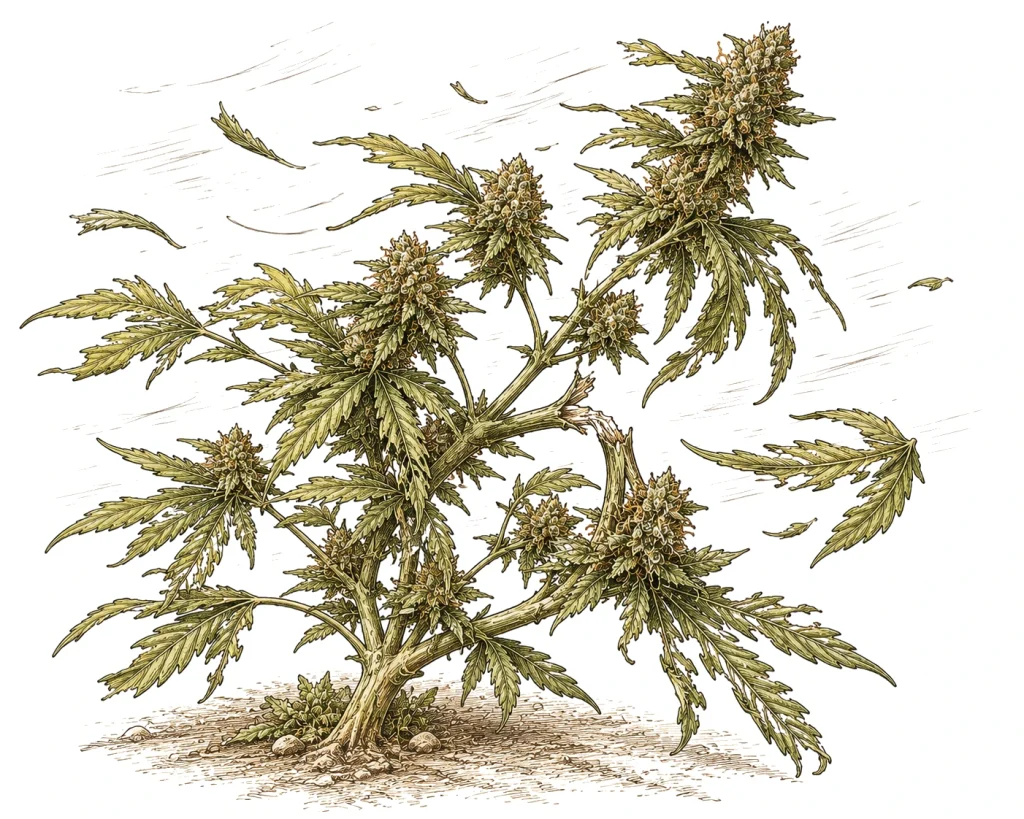
Cannabis wind damage (also known as windburn) is underestimated by many growers — yet constant wind stress can weaken your plant just as much as a nutrient deficiency or improper watering. Strong wind tears at leaves, snaps branches and disrupts the plant’s entire metabolism. If you recognize the typical signs early, you can act fast and prevent bigger damage. In this article, we explain what to look for and how to reliably protect your cannabis plants from wind damage.
Cannabis wind damage symptoms: the signs you should know
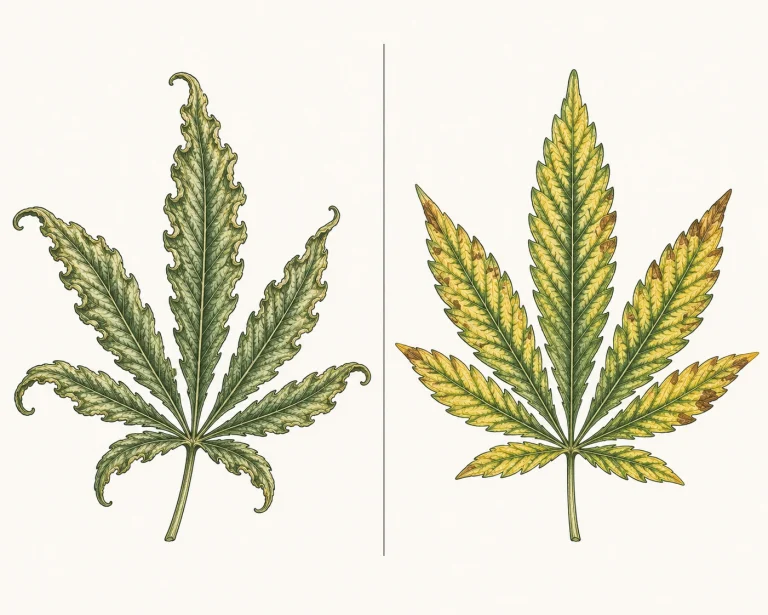
The most common symptoms of cannabis wind damage fall into three categories: mechanical damage to leaves and branches, physiological stress from excessive transpiration, and long-term stunted growth. Among the first visible signs are wavy or downward curling leaf edges, which are often mistaken for heat stress. The key difference: with pure wind stress, the symptoms usually show up on the side facing the wind or are spread evenly over the whole plant.
Another typical symptom is so-called wind spots — small, irregular brownish or yellowish discolorations on the leaf surfaces caused by leaves constantly rubbing against each other. These spots can be mistaken for mold or pests, but they show no fungal structures or feeding marks. Leaf tips that look brown and dry can also be caused by excessive wind stress, because the wind dries out the leaf surface.
A particularly obvious sign of severe wind damage is so-called “wind break”: branches and the main stem can bend or snap in sudden gusts. Young plants in the seedling and early vegetative stage are especially vulnerable because their tissue is still soft and barely woody. Even a short storm can drastically set back unprotected seedlings or destroy the little plant completely.
- Curled or wavy leaf edges (especially on the underside of the leaf)
- Brown, dry leaf tips with no visible nutrient deficiency
- Irregular wind spots from leaves rubbing together
- Bent or broken branches and stems
- Stunted, lopsided growth from constant wind from one direction
- Wilted look despite adequate watering
- Slowed or stalled growth
Why cannabis wind damage is so dangerous
In moderation, wind actually helps cannabis plants: gentle air movement strengthens the stems, improves CO2 exchange at the leaves and lowers humidity right at the leaf surface — which helps prevent mold. Cannabis wind damage starts when the wind is too strong, too constant or comes from changing directions. The plant then has to keep spending energy to counter mechanical damage instead of putting that energy into growth.
At its physiological core, the problem is transpiration. Strong wind massively increases the evaporation rate at the leaves. The plant loses more water than its roots can take up — a condition botanists describe as “wind-induced transpiration overload.” The result is temporary wilting, even when the soil is moist enough. If this continues, the plant starts closing its stomata (leaf pores) permanently, which restricts gas exchange and therefore photosynthesis.
Strong wind also damages leaf tissue directly: leaves that constantly beat against each other or against the stem develop micro-tears in the leaf structure. These small injuries open entry points for fungi and bacteria. In the worst case, wounds caused by wind damage can lead to bud rot (botrytis, gray mold) or other infections, especially when humidity is high at the same time.
- Excessive transpiration causes water stress despite moist soil
- Permanently closed stomata slow down photosynthesis
- Mechanical leaf damage opens entry points for fungi
- High energy use for self-stabilization instead of growth
- Cold wind adds cold stress and increases the plant’s overall stress
Telling cannabis wind damage apart from other problems
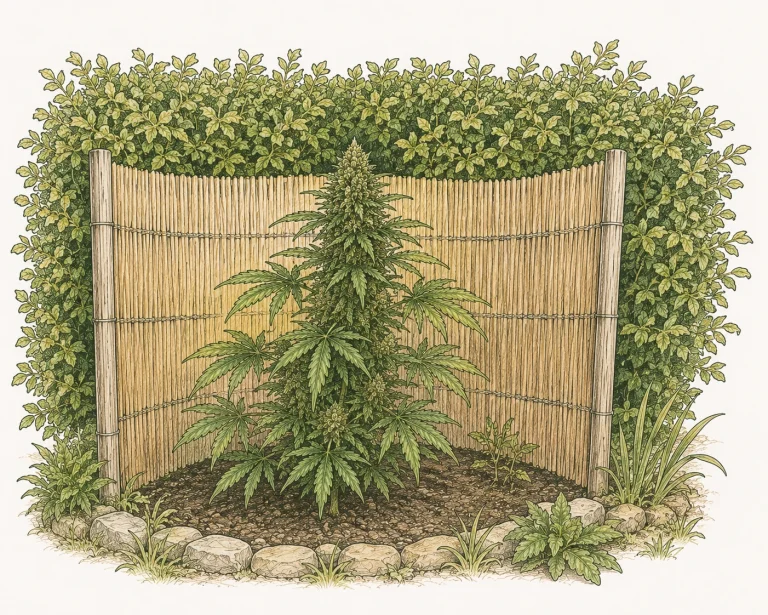
The biggest challenge with cannabis wind damage is telling it apart from other common problems. Curled leaves are also typical of heat stress, nutrient burn or overwatering. The decisive clue is the context: do the symptoms get worse on windy days or after storms? Is the damage one-sided, or does it hit the parts of the plant facing the wind especially hard? If so, wind stress is likely the main cause.
Brown leaf tips can also point to a calcium deficiency in cannabis or the wrong pH. With wind damage, the tips start to turn brown evenly, without chlorosis (yellowing) coming first or spreading inward. With nutrient deficiencies, on the other hand, you often see patterns like interveinal discoloration or a specific progression from older to newer growth. If you’re unsure, the Plant Diagnosis overview on PlantClue will quickly point you in the right direction.
Wilting plants despite moist soil are a classic sign of wind stress, but they can also point to root problems. Check the wind conditions at your location first before spending a lot of effort looking for other causes. A simple method: put up a temporary windbreak and watch whether the plant’s appearance improves within 24 to 48 hours. If the plant recovers quickly, wind really was the trigger.
- Wind damage: symptoms get worse after windy days or storms
- Brown tips without prior yellowing — typical of wind stress
- One-sided damage on the wind-exposed side of the plant
- Wilting despite sufficiently moist soil — a classic sign of wind stress
- Quick recovery after putting up a windbreak confirms the diagnosis
- No mold and no feeding marks with wind spots
Wind protection for outdoor cannabis: how to protect your plants
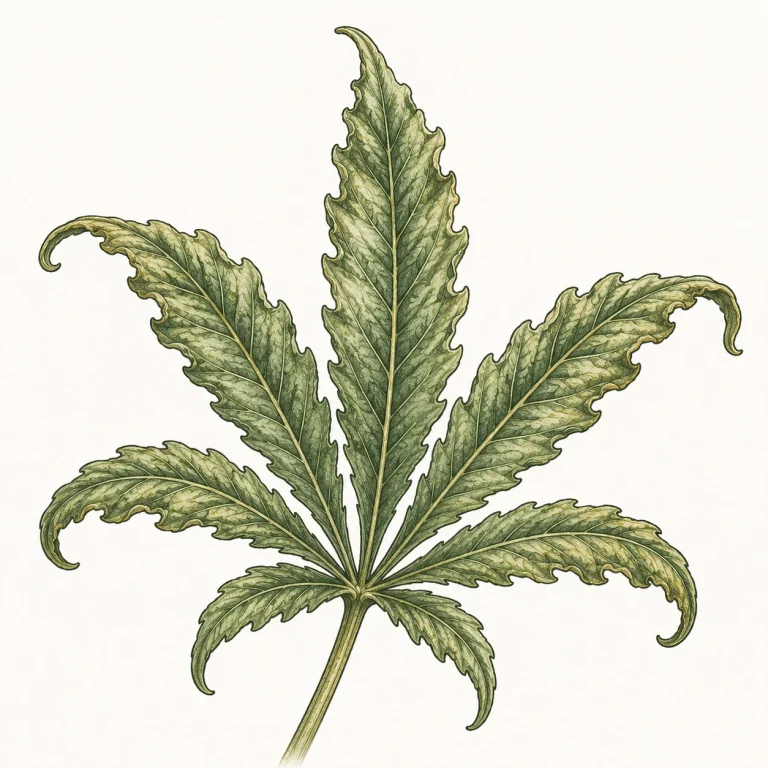
The most effective protection against cannabis wind damage is choosing your spot carefully. Ideal outdoor locations are in a natural hollow, next to a house wall or behind a hedge that acts as a windbreak. Important: the windbreak shouldn’t block the wind completely, just slow it down a lot. An environment with too little wind encourages mold and keeps the plant from building the mechanical strength it needs for sturdy stems.
Artificial windbreaks are a simple and inexpensive solution. Reed mats, windbreak netting or fleece barriers set up around the bed or container reduce wind speed by up to 70 percent. Make sure the barrier is firmly anchored — otherwise it becomes a problem itself in a storm. For movable potted plants, the easiest fix is to move the pots into the shelter of the house or a garage when a storm is forecast.
Preventive, controlled air movement indoors or in greenhouses has an underrated effect: if you train your plants from the start with a gentle fan in the grow tent, they develop thicker, more resilient stems. This so-called thigmomorphogenesis — growth in response to mechanical stimulation — makes the plant much more storm-resistant. Controlled airflow with an oscillating fan is a standard measure when growing cannabis indoors — it prevents mold and produces sturdy plants at the same time.
- Choose a naturally sheltered spot: hollows, house walls and hedges as natural windbreaks
- Set up reed mats or windbreak netting around the bed
- Bring movable potted plants indoors during storms
- Gentle airflow early on strengthens stems and improves storm resistance
- Never make a windbreak completely solid — keep air circulating
- Increase spacing between plants to reduce leaf rubbing
Treating cannabis wind damage: what to do after a storm
If your plant has already suffered wind damage, you need to act quickly but calmly. First, check the plant for mechanical damage: bent or broken branches that are still attached — and the main stem, too — can be stabilized with plant tape or electrical tape. The “taping” technique — wrapping the bend with elastic tape — often lets the plant heal the injury itself and even come back stronger than before. Cut off completely broken branches cleanly so no entry points for pathogens are left.
After wind damage from a stormy night, also watch closely for signs of mold. Damaged leaf tissue is susceptible to bud rot and other fungal infections, especially when the weather is damp at the same time. Consistently remove badly damaged leaves to improve airflow and minimize the risk of infection. A preventive treatment with a biological fungicide based on Bacillus subtilis can also help here.
Watch your plant especially closely in the days after the wind damage. Don’t overwater, because weakened roots take up water less efficiently — proper watering for cannabis is especially important now. Give the plant time to recover and avoid nutrient stress at the same time. If you’re close to harvest, wind damage can push back your schedule — so check your plants’ ripeness thoroughly once more.
- Fix bent branches right away with plant tape and let them heal
- Cut off broken branches cleanly — don’t leave open breaks
- Remove badly damaged leaves to prevent mold
- Watch for bud rot: damp weather after a storm greatly increases the risk
- Adjust watering: don’t overdo it after a stress event
- Avoid nutrient stress and give the plant time to recover
Cannabis wind damage symptoms outdoors vs. indoors
When growing outdoors, wind damage is one of the most common and most underestimated challenges. Especially in windy regions, on exposed slopes or on open balconies without a windbreak, strong gusts can wipe out weeks of work within a few hours. In the sensitive flowering stage in particular, when the buds are already well developed, a storm can drastically reduce your yield — either through direct mechanical damage to the buds or through moisture getting into dense buds, which encourages mold.
In an indoor grow, real wind damage from the elements is obviously not an issue. Here, wind-like stress comes from fans that are set too high, sit too close to the plants or point constantly at one spot. The symptoms are identical to real wind stress: curled leaves, dry tips, lopsided growth. The fix is simple: move fans farther away from the plants, switch to oscillating models and turn down the fan speed. Set up correctly, a fan in an indoor grow does more good than harm.
Cannabis plants on a balcony are a special case. Here, channeled winds often hit the plants at high speed — a phenomenon that the so-called chimney effect between buildings amplifies in cities. If you grow cannabis on a balcony, plan for windbreak netting or a privacy screen from the start, and choose especially compact, sturdy strains that give the wind less surface to grab.
- Outdoors: a storm during flowering is the biggest wind risk
- Indoors: fans that are too strong or poorly positioned cause the same symptoms
- Balcony: the chimney effect amplifies wind between buildings
- Compact, sturdy strains give the wind less surface to grab
- Protect the flowering stage especially well — mold after storms is common
Wind protection and rain protection often go hand in hand — learn more in our article on rain protection. For an overview of other typical outdoor problems, check out our guide to outdoor cannabis problems.
Frequently asked questions
How can I tell if my cannabis plant has wind damage?
Typical cannabis wind damage symptoms are curled or wavy leaf edges, brown dry leaf tips, irregular wind spots from leaves rubbing together, and bent branches. The symptoms often get worse after windy days and are frequently more pronounced on one side of the plant. A simple test: put up a temporary windbreak — if the plant recovers within 24 to 48 hours, wind was the cause.
Can wind damage be dangerous for cannabis?
Yes, cannabis wind damage from constant wind stress can be significant. Besides direct mechanical damage like broken branches, wind stresses the plant physiologically through excessive transpiration. The combination of wind damage and damp weather is especially dangerous, because injured plant parts are easy entry points for bud rot (gray mold) and other fungal infections. That’s why early action and wind protection matter.
How can I protect my outdoor cannabis grow from wind?
The best protection is choosing a spot carefully behind natural windbreaks like hedges or house walls. Windbreak netting, reed mats or fleece barriers that cut wind speed by up to 70 percent also help. You can move potted plants indoors when a storm is forecast. Also choose compact, sturdy strains that give the wind less surface to grab.
What should I do with my cannabis plant after a storm?
First, check the plant for mechanical damage. You can fix bent branches that are still attached with plant tape — they often heal completely. Cut off broken branches cleanly. Remove badly damaged leaves to reduce the risk of mold. Cut back on watering for a while and watch for signs of bud rot. Pause feeding for the next few days and give the plant time to recover.
Can a fan in a grow tent cause wind damage?
Yes, a fan that’s set too strong or too close in an indoor grow causes exactly the same symptoms as real wind stress: curled leaves, dry tips and lopsided growth. The fix: position the fan farther from the plants, switch to an oscillating model and turn down the power. Gentle, even air movement is ideal and even trains sturdier stems.
Can wind damage in cannabis be confused with heat stress?
Both problems can cause curled leaves as a symptom, but you can tell them apart. With heat stress, leaves often roll inward into a tube (like a cigar), frequently together with bleached or browned upper leaves close to the light source. Wind stress shows more wavy leaf edges, wind spots from leaves rubbing together and a one-sided pattern of damage. Wind damage also gets worse specifically after windy periods.
Is windburn on cannabis the same as wind damage?
Yes, windburn is a common alternative term for wind damage on cannabis and describes exactly the same symptoms: curled leaf edges, brown leaf tips and the typical wind spots from leaves rubbing together. Don’t confuse windburn with sunburn, though — despite the similar name, windburn has nothing to do with heat or direct light; it’s caused by mechanical stress and excessive evaporation in strong drafts. The treatment is identical: put up a windbreak, keep an eye on the affected leaves and give the plant time to recover.
Conclusion
Spotting cannabis wind damage symptoms early can make the difference between a successful harvest and a significant loss. Curled leaves, brown tips, wind spots and bent branches are clear warning signs you should respond to quickly. With the right location, targeted wind protection and careful checks after storms, you can protect your plants effectively. Remember: a little wind is good for the plant — too much of it drains its energy and opens the door to disease.
