

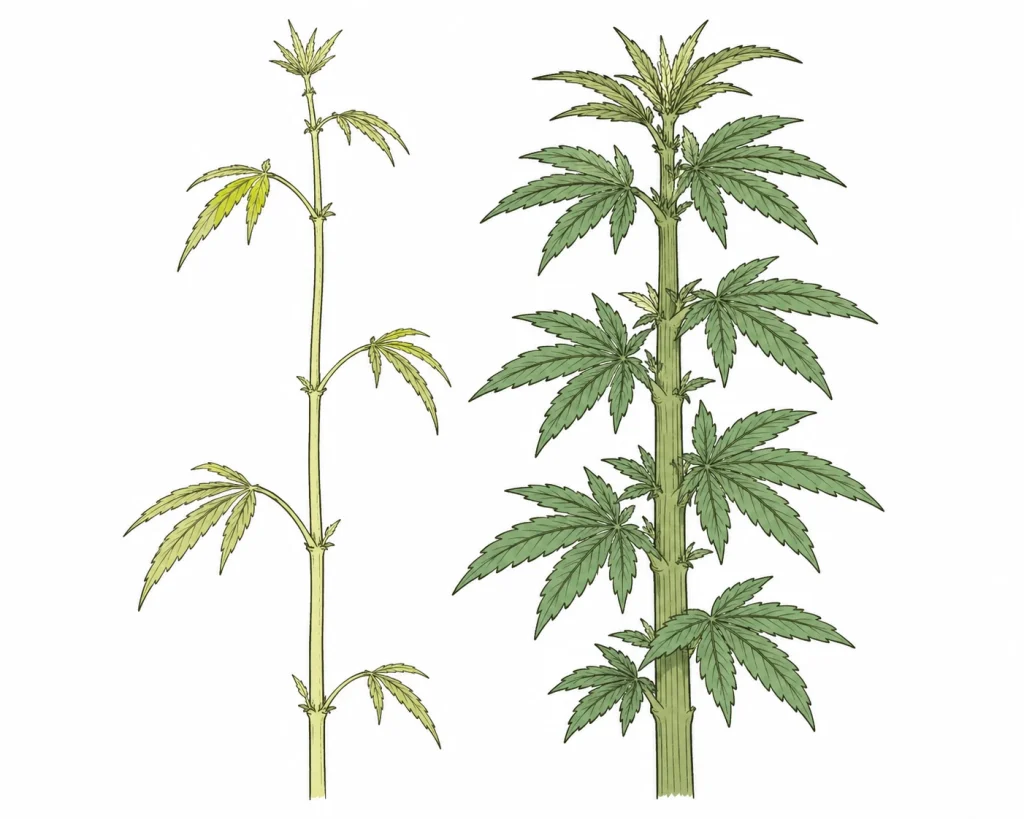
Knowing what causes thin stems in cannabis is key, because a weak stem isn’t just a cosmetic problem – it signals that the plant is under stress and can’t reach its full yield potential. Thin, unstable stems can cause heavy buds to snap, restrict nutrient flow and make the plant more vulnerable to diseases and pests. The good news: in most cases, you can identify the causes quickly and fix them with targeted measures. In this article, we at PlantClue explain which factors are behind thin stems and how to get your plant back on track step by step.
Cannabis thin stems: what the problem looks like
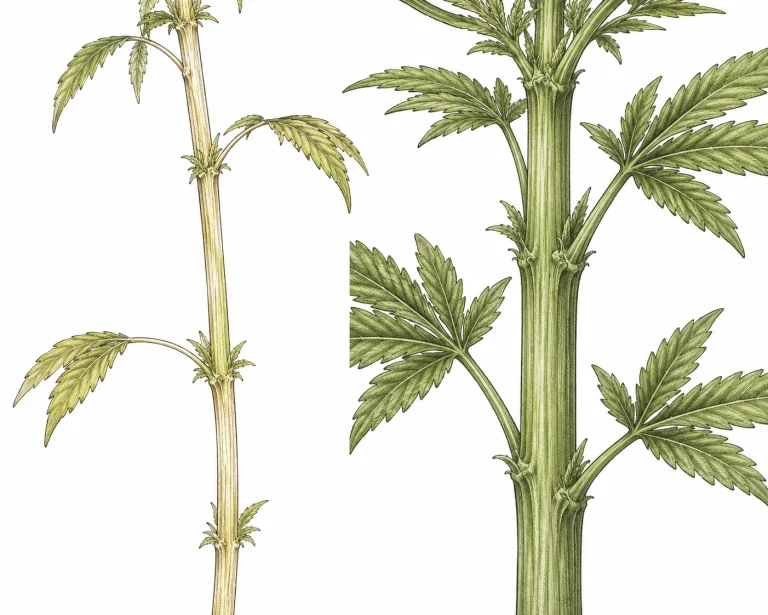
Healthy cannabis plants develop strong, woody stems that can easily carry the weight of the buds. If your plant grows thin, soft or overly long stems instead, this is often called etiolation – a condition in which the plant puts its energy into height instead of substance. The internode spacing, meaning the distance between the individual leaf pairs, is often unnaturally large.
Another sign of thin stems is their lack of stability: the plant tips over easily, needs support or leans constantly toward the light source. This problem is especially obvious in seedlings and young plants, but it can also show up in the vegetative stage when conditions aren’t right. If you spot the symptoms early, you can correct course quickly and prevent bigger damage.
- Overly long, thin stems with wide internode spacing
- Stem bends or snaps under its own weight
- Pale, yellowish-green stem color
- Plant grows tall instead of bushy and compact
- Leaves look limp or droop slightly
- Seedlings fall over or need external support
Cannabis thin stems causes: the most common triggers at a glance
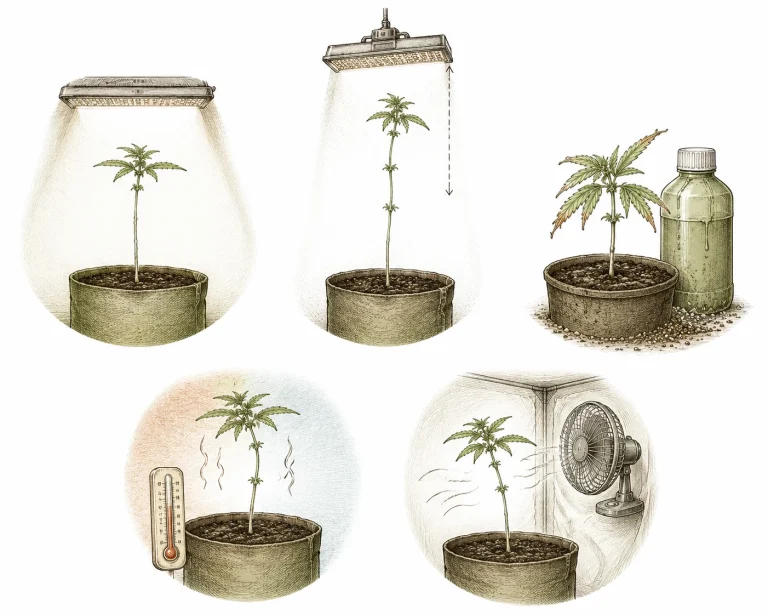
By far the most common cause of thin stems in cannabis is insufficient light. If the light source is too far from the plant or simply too weak, the plant starts stretching toward the light. This process, known as etiolation, makes the plant put its energy into height and lose stability along the way. This problem is especially common with cheap LED lamps or regular compact fluorescent (CFL) bulbs.
Another common trigger is a lack of air movement. In nature, wind puts mechanical stress on plant stems, which makes them thicker and sturdier. This process is called thigmomorphogenesis. In a grow tent without enough air circulation, this natural training stimulus is missing completely, which leads to soft, unstable stems. Too much nitrogen can paradoxically contribute to thin stems as well: excessive vegetative growth from too much nitrogen produces long shoots, but not correspondingly sturdy stems.
Finally, temperature and growing medium also play a role. Temperatures that are too high, especially combined with poor air circulation, encourage excessive stretching. A growing medium that is too low in nutrients or poorly balanced can leave the plant short of essential nutrients like calcium, silicon or phosphorus – all elements that contribute to cell wall strength. Also read our article on calcium deficiency in cannabis, which can be closely linked to weak stem structures.
- Lack of light or too much distance from the light source (most common cause)
- Missing air circulation and no mechanical stress from wind
- Too much nitrogen: lots of vegetative growth without strength
- Temperatures too high in the grow tent (above 82–86 °F / 28–30 °C)
- Lack of calcium, silicon or phosphorus in the growing medium
- Sowing too deep or too little light during germination
- Genetic weakness in certain sativa-dominant strains
Lack of light as the main cause: why your cannabis plant is stretching
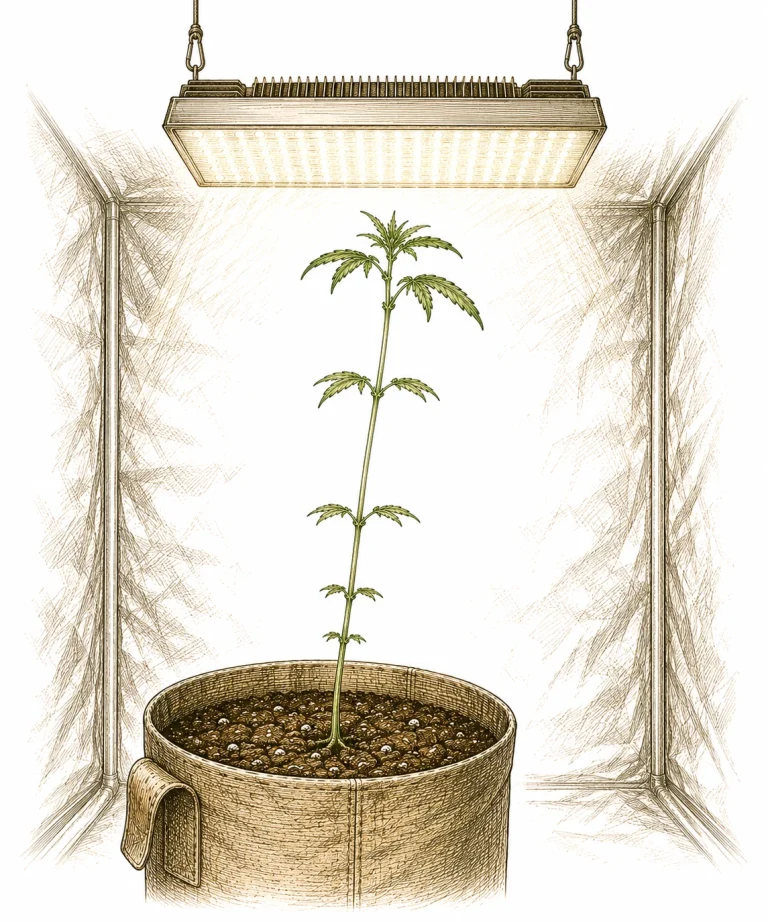
Light is the most important factor for compact, vigorous growth in cannabis. If the light intensity is too low – measured as PPFD (photosynthetic photon flux density) – the plant switches into search mode: it produces more auxins, a growth hormone that promotes stretching. The result is long, soft internodes and thin stems that aren’t structurally stable enough to carry heavy buds later on.
For seedlings, PPFD values between 200 and 400 µmol/m²/s are recommended; for the vegetative stage , between 400 and 600 µmol/m²/s. In the flowering stage , values of 600 to 900 µmol/m²/s and more can be appropriate. The correct lamp distance is important here: a high-quality full-spectrum LED should usually hang 16 to 24 in (40 to 60 cm) above seedlings, and 12 to 20 in (30 to 50 cm) in veg, depending on the model. If your lamp hangs too high, the plant gets too few photons and will inevitably stretch.
Skip the classic hand-warmth test: modern LEDs give off hardly any heat, so you can’t reliably judge their light intensity that way. Invest in an inexpensive lux or PPFD meter to get reliable readings. Also pay attention to the quality of your lamp: cheap blurple LEDs or outdated HPS lamps often don’t deliver the full spectrum cannabis needs for optimal growth.
- PPFD for seedlings: 200–400 µmol/m²/s
- PPFD in the vegetative stage: 400–600 µmol/m²/s
- PPFD in the flowering stage: 600–900+ µmol/m²/s
- LED lamp distance in veg: 12–20 in (30–50 cm), depending on the model
- Use a lux meter or PPFD meter to check
- Choose high-quality full-spectrum LEDs
Improve air circulation: strengthen stems through mechanical stress
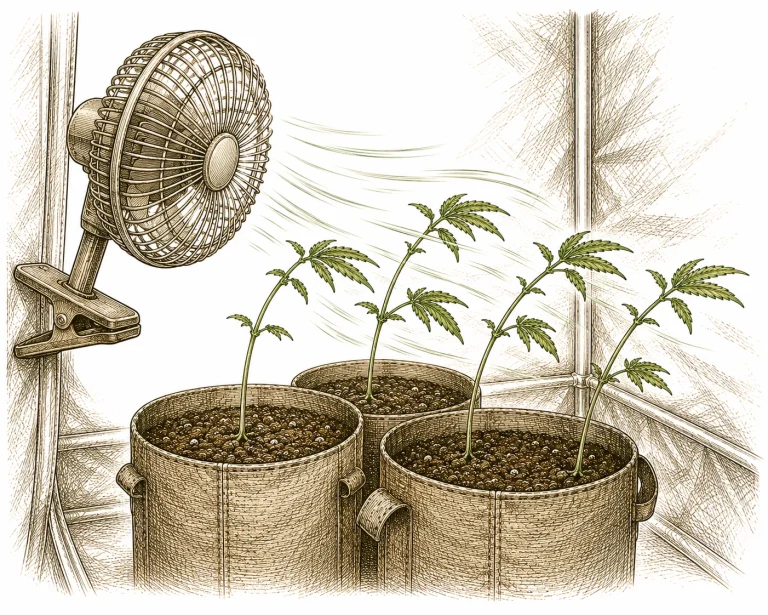
One of the simplest and most effective remedies for thin cannabis stems is a simple fan. The mechanical movement created by air currents signals the plant that it has to resist external forces. In response, it produces more cellulose and lignin in the stem cells, which leads to thicker, sturdier stems – a process biologists call thigmomorphogenesis.
For a standard grow tent, a small clip fan running on a low setting and gently blowing over the tops of the plants is enough. It’s important that the airflow isn’t too strong – it should make the stems sway slightly, but not bend them hard or dry them out. A constant, gentle airflow is better than a strong, intermittent breeze. Also make sure the fan distributes the air well and doesn’t leave dead zones where warm, humid air collects.
Besides strengthening the stems directly, good air circulation has other benefits: it lowers the humidity around the leaves, reduces the risk of mold and powdery mildew and makes sure CO₂ reaches all leaves evenly. Good air circulation is therefore one of the most fundamental parts of a successful indoor grow, as our guide to growing cannabis indoors explains in detail.
- Let a clip fan on a low setting blow gently over the tops
- Stems should move slightly, but not bend hard
- Running the fan constantly is better than running it on and off
- Air circulation also reduces the risk of mold and powdery mildew
- Don’t allow dead zones without air movement in the tent
Optimize feeding: dose nitrogen, calcium and silicon correctly
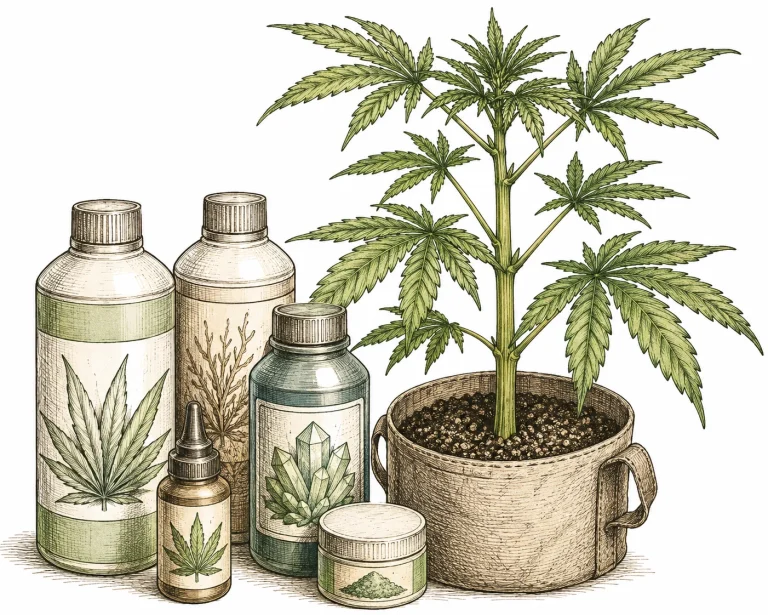
Too much nitrogen is an often overlooked trigger for thin stems. Nitrogen promotes vegetative growth and the production of chlorophyll, but when overdosed, it makes the plant shoot up quickly without building correspondingly strong support structures. The result: long, soft, unstable stems with dark green foliage. If you suspect you’re giving too much nitrogen, reduce the nutrient dose to 50–75% of the recommended amount and watch how the plant develops over a week. You’ll find more on this topic in our article on cannabis nutrient burn.
Calcium is an essential nutrient for cell wall strength. A calcium deficiency leads directly to weak tissue structures – not only in the leaves, but also in the stems. If your plant shows thin stems along with brown spots or wavy leaf edges, it could be a calcium deficiency. In that case, add a Cal-Mag supplement or check your pH, because calcium can’t be taken up when the pH is off.
Silicon is another often underestimated nutrient for sturdy stems. It is deposited in the cell walls, making the plant mechanically more stable and at the same time more resistant to pests and diseases. Silicon supplements like silicic acid or potassium silicate can make a big difference, especially in early veg. Important: mix silicon separately and add it before the rest of your nutrients, because it can react with other nutrients. Also check your cannabis pH regularly, because the plant can only take up all nutrients properly at the right pH.
- Cut back excess nitrogen: no more than 75% of the recommended dose in veg
- Use a Cal-Mag supplement if you suspect a calcium deficiency
- Keep the pH in the root zone at 6.0–7.0 (soil) or 5.5–6.5 (coco/hydro)
- Use silicon supplements (silicic acid, potassium silicate) for thicker cell walls
- Don’t neglect phosphorus in veg – it’s important for strong roots and stems
- EC (electrical conductivity): measure it regularly to catch overfeeding or underfeeding
Quick fixes for thin stems: what you can do right now
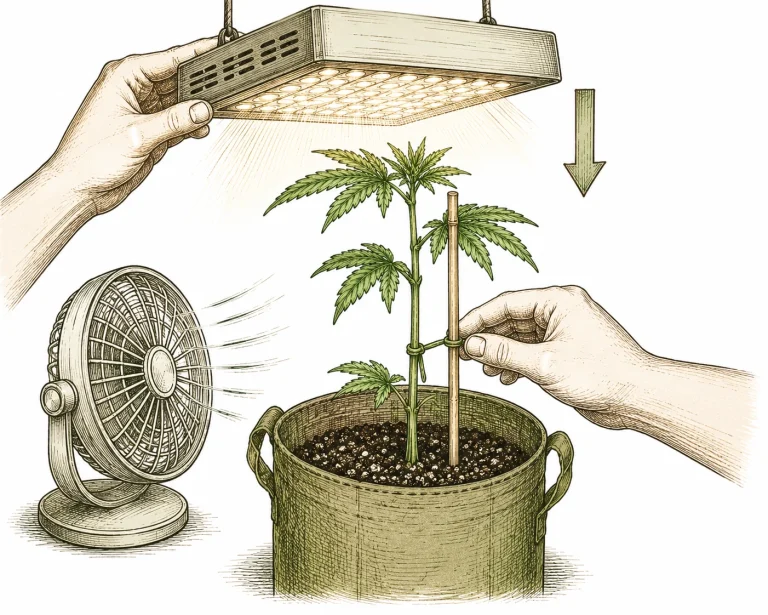
If you notice that your plant has already developed very thin, unstable stems, there are a few quick fixes you should put in place immediately. First, lower your light source or increase the light intensity to stop the stretching. Keep the recommended minimum distances for your type of lamp and ideally double-check with a PPFD meter. A plant that has already stretched won’t undo the long internodes, but you can stop further stretching right away.
To keep the plant from falling over, you can support it temporarily with a bamboo stake or plant stake. Tie the stem loosely with soft ties – never too tight, as that can restrict nutrient flow. At the same time, set up a fan right away and make sure there’s even, gentle air movement. These two measures alone can make a noticeable difference within a few days.
For seedlings that have stretched badly (etiolated) and can barely stand, it can help to bury the stem slightly deeper, up to just below the cotyledons. Cannabis grows new roots on buried stem sections (adventitious roots), which stabilizes the plant and enlarges the root system at the same time. Make sure the growing medium can be moistened evenly and the buried part doesn’t rot – a loose, well-draining growing medium is a must for this. If you’re unsure about the right watering routine, our guide on how to water cannabis plants will help.
- Lower the lamp right away or increase the intensity
- Switch on a fan for immediate mechanical stimulation
- Temporary support with a bamboo stake and soft ties
- For badly etiolated seedlings: replant the stem deeper, up to just below the cotyledons
- Reduce nitrogen, add Cal-Mag and silicon
- Lower the temperature in the tent to 68–79 °F (20–26 °C) if it’s too warm
Preventing cannabis thin stems long term: preventive measures for sturdy plants
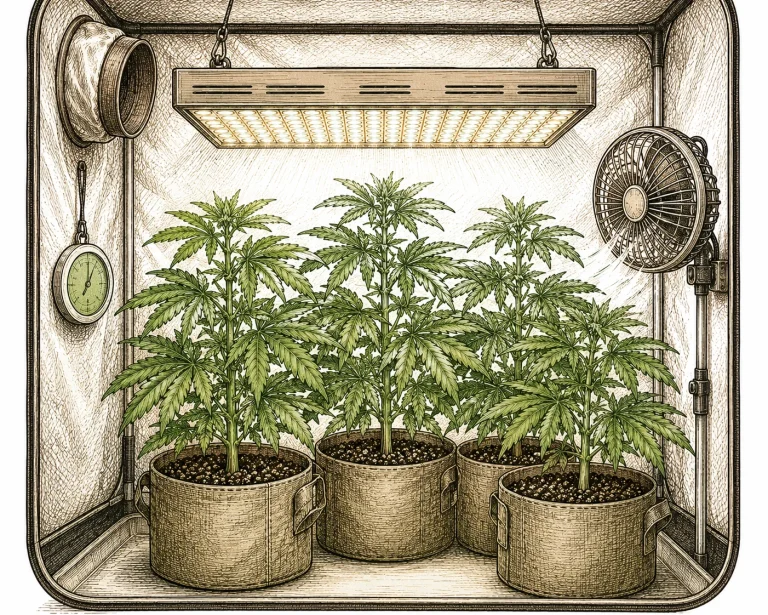
When it comes to thin stems, prevention is much easier than fixing the problem later. Start with the right conditions from the beginning: make sure your light source hangs at the right height and delivers enough light intensity from the very first hour. Many beginners underestimate how much light cannabis seedlings need and hang the lamp too high to protect the little plants – that backfires. As long as the lamp doesn’t get too hot and you keep the correct minimum distance, it can be close to the plant.
Set up a fan from the start and provide continuous, gentle air movement. The investment is minimal and the effect on stem strength is huge. Add a silicon supplement to your feeding schedule from the beginning and make sure the pH is always in the optimal range – because even if all nutrients are present, the plant can’t take them up when the pH is off. Also check whether your growing medium is suitable for cannabis and provides enough nutrients without overfeeding the plant.
From a breeding point of view, indica-dominant strains or certain autoflowering genetics with a naturally compact growth habit can reduce the problem of thin stems. Sativa-dominant strains are genetically prone to longer internodes and slimmer stems – if you grow such strains, pay special attention to light intensity and air movement from the start. Techniques like low stress training (LST) also help keep the plant flat and bushy and improve light distribution, which indirectly leads to sturdier stems at several bud sites.
- Make sure you have enough light intensity and the right lamp distance from the start
- Set up a fan from the first week for continuous air movement
- Add silicon supplements to your feeding schedule regularly
- Monitor the pH consistently and keep it in the optimal range
- Choose indica-dominant strains or autoflowers for a naturally more compact structure
- Use LST and other training methods to encourage bushy growth
- Use a growing medium with balanced nutrients and good drainage
That mechanical stimuli such as wind or touch specifically strengthen plant stems is confirmed by a recent review on thigmomorphogenesis: mechanical stimulation can increase the lignin content in plant stems by up to 40% and thus significantly improve stem stability.
Frequently asked questions
Why are my cannabis seedlings’ stems so thin and long?
The most common reason is not enough light or too much distance between the lamp and the plant. The seedlings stretch (etiolate) in search of light and grow long, thin internodes. The fix: lower the lamp, increase the light intensity and set up a fan at the same time.
Can I still save a stem that’s already thin and long?
Yes! You can support the stem temporarily with a bamboo stake and improve the growing conditions right away (more light, a fan). With seedlings, it helps to replant them deeper – cannabis then grows adventitious roots on the buried part. The long internodes that have already formed will stay, but new growth will be more compact.
How far should my LED light be from my cannabis plants?
That depends on the lamp model and the growth stage. As a rule of thumb: about 16–24 in (40–60 cm) for seedlings and in early veg; with powerful full-spectrum LEDs, you can reduce the distance to 12–16 in (30–40 cm) in the flowering stage. Always follow the manufacturer’s recommendations and ideally double-check with a PPFD meter.
Does more fertilizer help against thin stems in cannabis?
Not across the board – quite the opposite. Too much nitrogen can actually promote thin stems because it encourages excessive stretching. What does make sense is targeted supplementation with calcium (Cal-Mag) and silicon, which contribute to cell wall strength. Check your pH first before you feed more nutrients.
Which nutrients are important for strong cannabis stems?
Calcium is the most important nutrient for cell wall strength – a deficiency leads directly to weak tissue. Silicon (silicic acid) is deposited in the cell walls and makes stems mechanically sturdier. Phosphorus supports root growth and indirectly contributes to stem strength. Make sure your pH is right so all nutrients can be taken up properly.
Is a fan really that important for thick cannabis stems?
Absolutely. The process is called thigmomorphogenesis: mechanical stress from wind signals the plant that it needs stronger support structures. Cannabis responds with thicker, lignin-rich stem cells. Even a small clip fan on a low setting is enough to get this effect.
Can thin stems in cannabis also be genetic?
Yes, sativa-dominant strains naturally have longer internodes and slimmer stems than indica-dominant strains. That’s normal and not a sign of disease. Even so, sativa plants can also develop much sturdier stems with optimal lighting, air movement and silicon supplements than without these measures.
Conclusion
In most cases, thin stems in cannabis come down to a lack of light, missing air circulation or the wrong nutrient supply – all factors you control directly as a grower. With the right quick fixes, like lowering the lamp, setting up a fan and adding silicon supplements, you can stop further stretching, and new shoots will grow noticeably sturdier. In the long run, optimal light intensity, continuous air movement and balanced nutrient management make sure your plants develop stable, load-bearing stems from the start. If you get these basics right from the beginning, you’ll be rewarded with bushy, high-yielding plants that easily carry the weight of heavy buds.
