

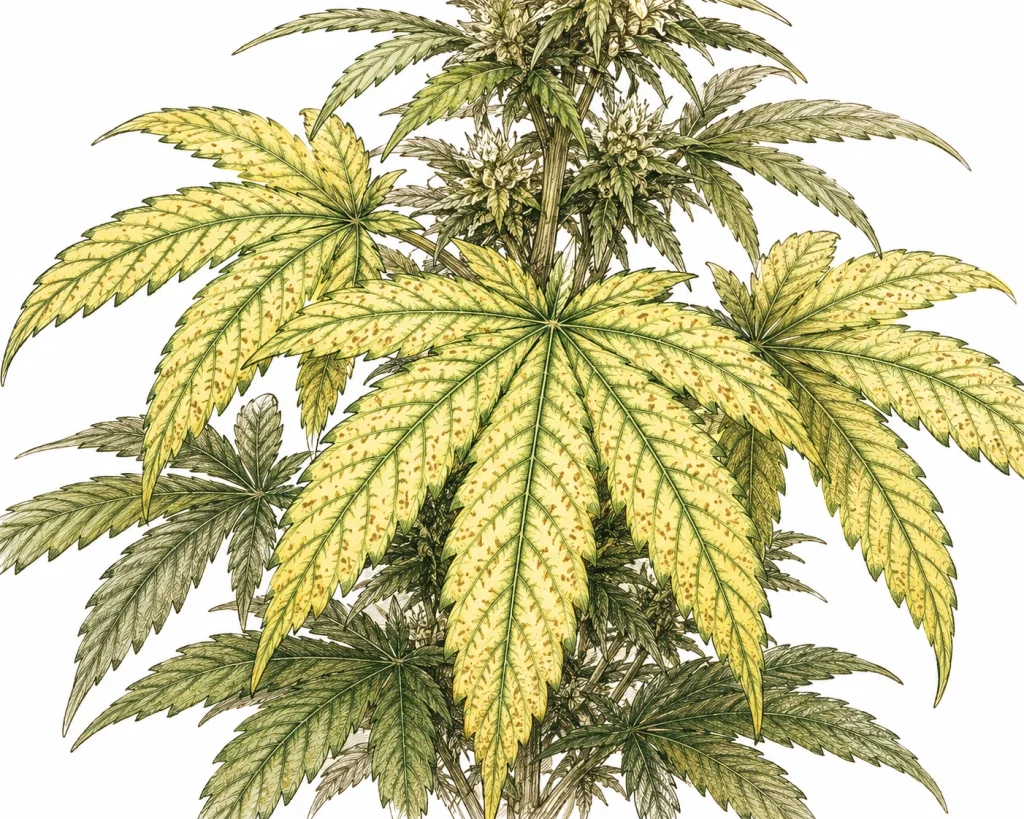
Many growers easily mistake cannabis manganese deficiency symptoms for other problems — yet an early diagnosis is crucial for a healthy harvest. Manganese is an essential micronutrient that plays a central role in photosynthesis, nitrogen uptake and enzyme activation. When it’s missing, characteristic discoloration shows up on the young leaves and can spread quickly. In this article, we explain how to reliably spot manganese deficiency, what causes it and how to fix it step by step. On the PlantClue Plant Diagnosis overview you’ll also find all other problems at a glance.
What is manganese and why does cannabis need this micronutrient?
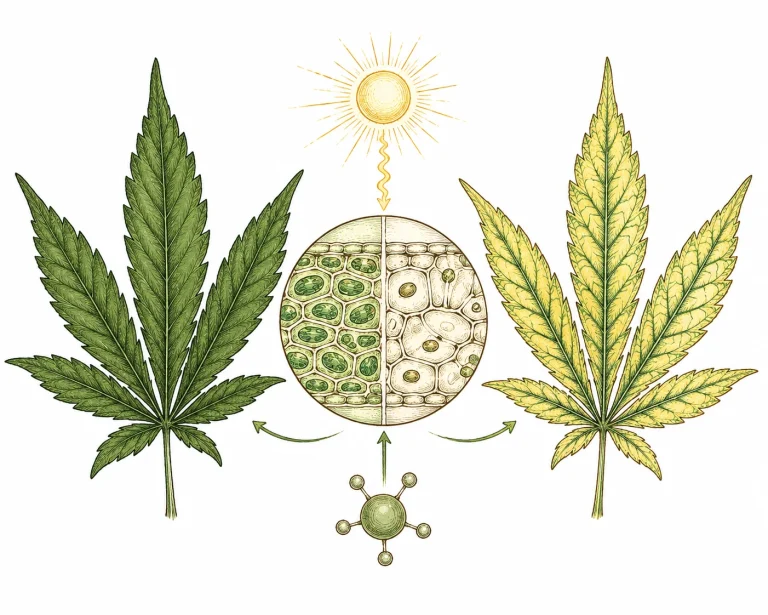
Manganese (Mn) is one of the so-called micronutrients: cannabis needs it only in relatively small amounts, but vital metabolic processes can’t work without it. Manganese is directly involved in photosynthesis by enabling water splitting in photosystem II — a fundamental step in how the plant gains energy. Manganese also activates numerous enzymes needed to use nitrogen and build chlorophyll.
Without enough manganese, your cannabis plant can’t use incoming light efficiently, which translates directly into slower growth and weaker bud development. Because manganese is a so-called immobile nutrient, the plant can’t move it from old leaves to young shoots. That’s why manganese deficiency symptoms show up first and most strongly on the new, young leaves — an important difference from mobile nutrients like nitrogen or magnesium, where symptoms appear on the old leaves first.
- Manganese is an immobile micronutrient: symptoms start on young leaves
- Essential role in photosystem II: water splitting and energy production
- Activates enzymes for chlorophyll synthesis and nitrogen use
- Manganese deficiency slows growth and reduces bud quality
Cannabis manganese deficiency symptoms: how to spot the problem for sure
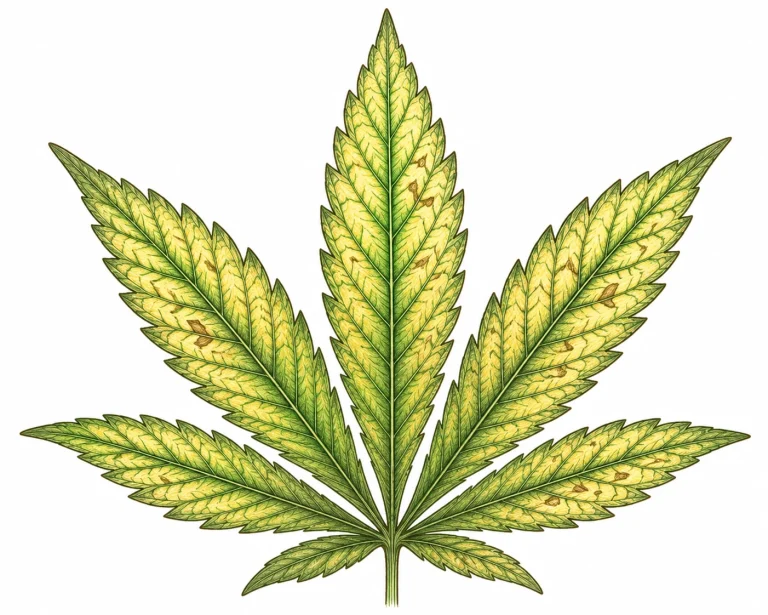
The hallmark symptom of cannabis manganese deficiency is so-called interveinal chlorosis on the young, newly growing leaves. That means the leaf veins themselves stay green, while the tissue between the veins turns increasingly yellowish to light green. This pattern sets manganese deficiency apart from a straightforward nitrogen deficiency, where the entire leaf surface fades evenly. Depending on how severe the deficiency is, the yellow areas can turn a pale, whitish shade.
As it progresses, small brown to reddish-brown necrotic dots or spots appear on the affected leaf surfaces. These spots are tiny and irregularly scattered at first, but if the manganese supply stays poor, they can merge into larger areas of dead tissue. Unlike calcium deficiency, which also causes brown spots, manganese deficiency always starts on the young shoots and new leaves — not on old leaves. If your plant has yellow leaves and you’re not sure which deficiency it is, checking the leaf position is a crucial first step.
In severe cases, the leaves can die back from the tip and wave downward or curl. Overall growth slows noticeably, the internodes get shorter and bud development stalls. If you can’t tell manganese deficiency apart from iron deficiency symptoms, look at the pattern: iron deficiency often starts on the very youngest leaves with an even, all-over paling, while manganese deficiency shows the typical vein pattern. You’ll find more on the differences between micronutrient deficiencies in the article on micronutrient deficiencies in cannabis.
- Interveinal chlorosis: leaf veins stay green, the tissue between them turns yellow
- Symptoms always start on young, new leaves — not on old ones
- Brown to reddish-brown necrotic spots follow as it progresses
- Leaves can curl, wave or die back from the tip
- Slower growth and disrupted bud development with a severe deficiency
- Difference from iron deficiency: vein pattern vs. even paling
Causes of manganese deficiency in cannabis: why does it happen?
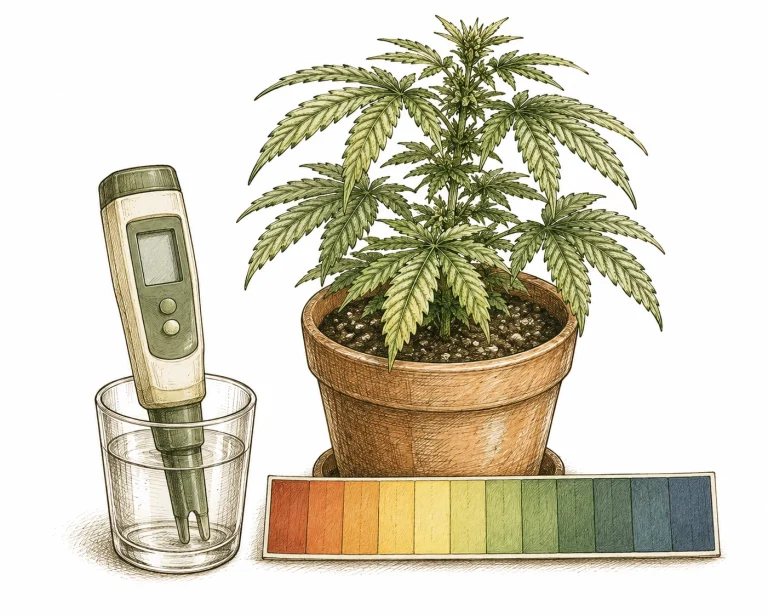
The most common cause of manganese deficiency in cannabis isn’t an actual lack of manganese in the growing medium, but the wrong pH, which blocks uptake. Manganese is only available to the roots within a certain pH range: in soil, the optimal range is 6.0–7.0, in hydroponics 5.5–6.5. If the pH rises above these limits, manganese gets chemically bound in the medium and the roots can no longer take it up — a phenomenon growers know as “nutrient lockout.” A wrong cannabis pH is therefore the first source of error you should check. The North Rhine-Westphalia Chamber of Agriculture’s information on trace elements (German) notes that manganese deficiency is especially common on lighter soils with a higher pH and high humus content — a pattern you’ll also find in cannabis growing media.
Another common cause is overfeeding other nutrients, especially iron, calcium or phosphorus. At high concentrations, these nutrients can competitively inhibit manganese uptake — they “crowd out” manganese at the uptake sites of the roots. This problem can come up especially with complete nutrients that have an unfavorable ratio between the individual nutrients. On top of that, too much phosphorus — typical of cannabis nutrient burn — is known to disrupt micronutrient uptake.
Manganese deficiency can also come from a growing medium that’s genuinely depleted of manganese — especially if you’ve run several grows with the same soil mix without adding fresh medium. Cold root zones, caused by low room temperatures or by overwatering with cold water, also inhibit manganese uptake. Finally, watering too often or too rarely can change the conditions in the growing medium enough to block manganese. If you water your plant correctly, you automatically create better conditions for a stable nutrient supply.
- Wrong pH is the most common cause: manganese gets blocked at a high pH
- Nutrient lockout from overfeeding iron, calcium or phosphorus
- Old, depleted growing medium contains too little manganese
- A cold root zone inhibits manganese uptake
- Poor watering habits throw off the conditions in the soil
How to fix cannabis manganese deficiency: step-by-step guide
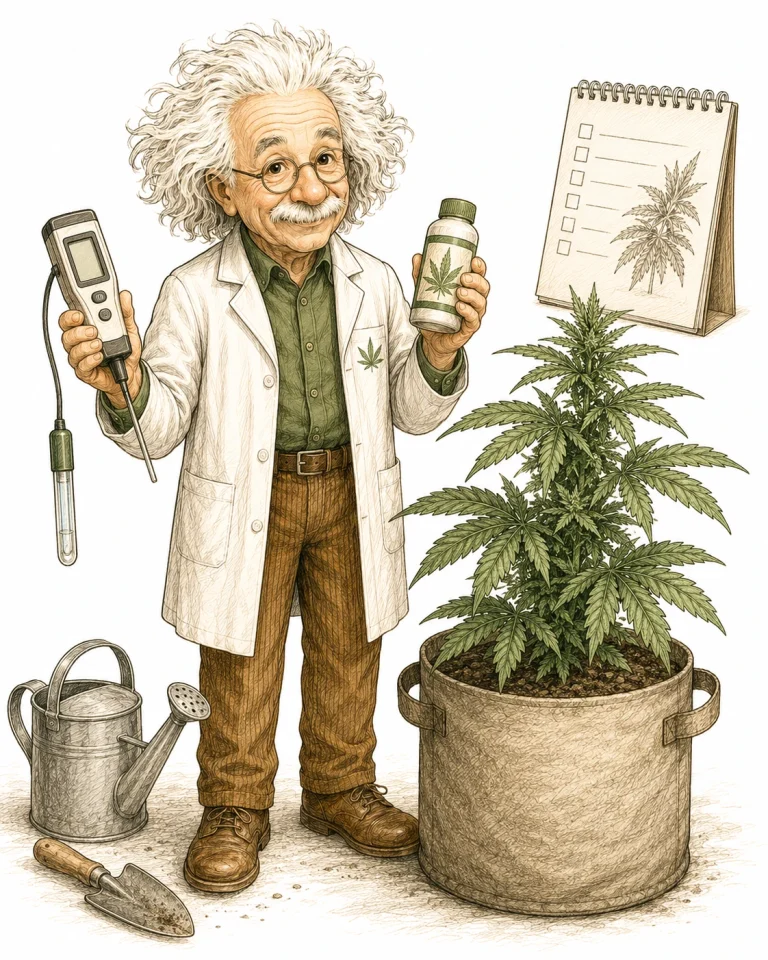
Step 1: Check and correct the pH. Before you buy or use any nutrient, measure the pH of your water and your growing medium. For soil grows, the value should be between 6.0 and 7.0, ideally 6.2–6.8. In hydroponic systems, 5.5–6.5 is considered the optimal range. If your pH is outside these limits, correct it first with a pH adjuster (pH Up or pH Down) and watch whether the symptoms improve within 3–5 days. Often the pH correction alone is enough to restore manganese uptake, without you having to add extra manganese.
Step 2: Flush the growing medium if you’ve overfed. If you suspect nutrient lockout from overfeeding, thoroughly rinsing the growing medium with pH-adjusted water (so-called “flushing”) can help. Slowly run two to three times the pot volume of water through the pot to wash out excess nutrient salts. Afterward, make sure there’s good drainage and let the growing medium dry out a bit before you feed again.
Step 3: Foliar feeding as first aid. With a severe manganese deficiency, foliar feeding with a manganese-containing micronutrient product can bring immediate relief, because the leaves absorb the nutrients directly and bypass the problematic soil pH. Dilute the product to about half the recommended concentration, spray the leaf undersides in the early evening or just as the grow light turns off, and repeat every 2–3 days until the symptoms recede. Avoid direct sunlight on wet leaves when spraying.
Step 4: Adjust your soil feeding. In the long run, add a high-quality micronutrient product that contains manganese, iron, zinc and other trace elements to your feeding schedule. Many standard cannabis base nutrients already contain manganese — check the product description. If your growing medium is completely depleted, switch to fresh, quality medium for the next grow. Well-built, living soil with compost and mycorrhizal fungi also improves the biological availability of micronutrients like manganese.
- Always check the pH first: soil 6.0–7.0, hydro 5.5–6.5
- Flush the growing medium after overfeeding and nutrient lockout
- Foliar feeding as fast first aid for a severe deficiency
- Add a micronutrient product with manganese to your feeding schedule
- Use fresh growing medium for the next grow if the soil is depleted
- Mycorrhizae and compost improve biological nutrient availability
Telling cannabis manganese deficiency apart from similar problems
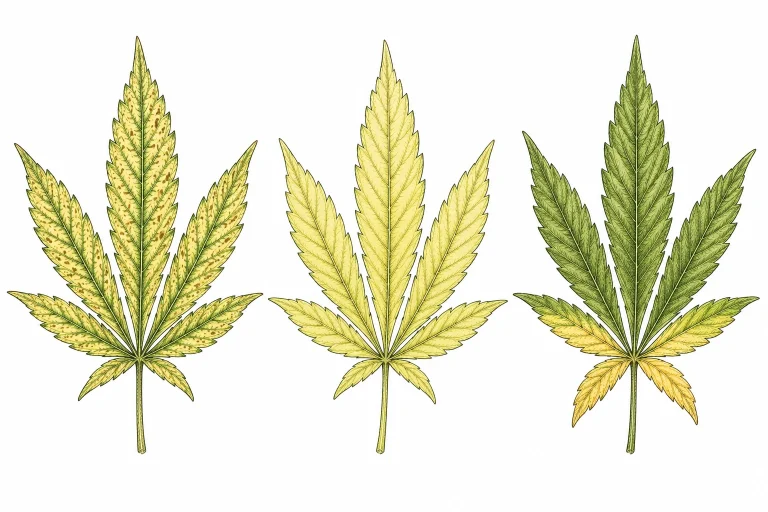
Manganese deficiency is most often confused with iron deficiency and magnesium deficiency, because all three cause a form of chlorosis. The most important difference from iron deficiency: with iron, the chlorosis is usually more even and hits the very youngest leaves first, while the vein network rarely stays as clearly visible as with manganese deficiency. With magnesium deficiency, on the other hand, the symptoms start on the older, lower leaves — because magnesium is a mobile nutrient. So if you’re unsure, always look at the position of the affected leaves first. New leaves affected? Manganese or iron deficiency is likely. Old leaves affected? More likely magnesium or nitrogen deficiency.
Calcium deficiency can also cause brown spots that look similar at first glance. But calcium deficiency in cannabis usually causes more irregular, rust-colored spots that can also appear on stems and growing tips. With manganese deficiency, the interveinal pattern stays clearly visible as the hallmark symptom before necrosis sets in. Light burn or heat stress are other common mix-ups: however, these tend to appear evenly across the leaf and affect the leaves closest to the light source — whether young or old.
For an overview of all major nutrient deficiencies and how to tell them apart, see the comprehensive article on spotting cannabis deficiencies. There you can work through it systematically and rule out what’s really going on with your plant. When in doubt: several symptoms at once? Then you may be dealing with pH lockout, which blocks several micronutrients.
- Iron deficiency: even paling of young leaves, less distinct vein pattern
- Magnesium deficiency: symptoms on old leaves, not on young shoots
- Calcium deficiency: irregular spots, also on stems and growing tips
- Light burn: affects leaves close to the light, regardless of age
- Several symptoms at once? Suspect pH lockout!
Preventing cannabis manganese deficiency: these measures protect your plant
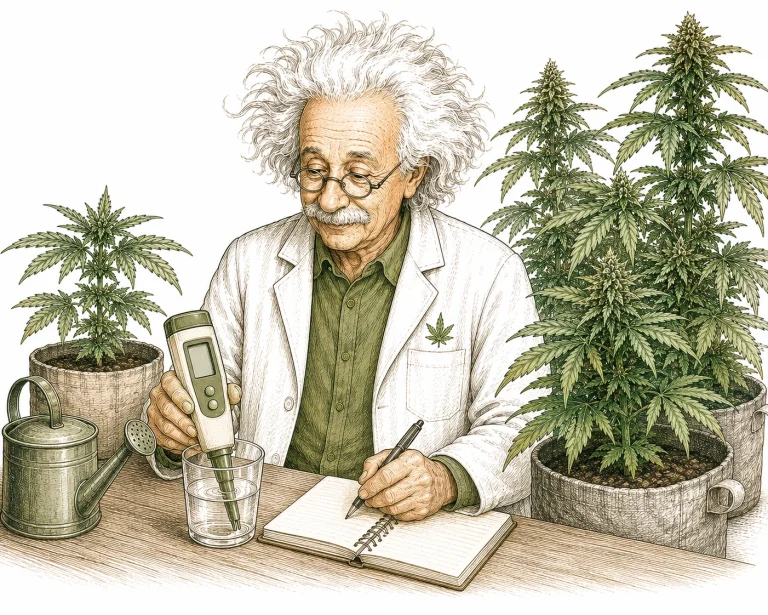
Prevention starts with consistent pH management. Ideally, measure the pH of your water every time you water, and check the runoff pH regularly to catch changes in the growing medium early. A grow journal where you record pH, EC, nutrient amounts and observations on the plant helps you spot trends before they become a problem. Experienced growers recommend checking the pH at least twice a week.
Use a high-quality growing medium from the start that’s made specifically for cannabis or at least for demanding plants. These soils already contain carefully balanced micronutrients, including manganese. Also add a complete micronutrient product to your feeding schedule early on, especially if you’re planning a long vegetative stage or the growing medium has already been used for a previous grow. Keep in mind that roots take up nutrients less efficiently in cold conditions: keep the root zone above 64 °F (18 °C) and water with room-temperature water whenever possible. You’ll find all the basics for a successful grow that keeps deficiencies to a minimum from the start in the indoor cannabis growing guide.
- Measure the pH regularly: at least twice a week
- Keep a grow journal: record pH, EC, feeding and observation data
- Use a high-quality, cannabis-friendly growing medium with micronutrients
- Add a micronutrient product to your feeding schedule proactively
- Keep the root zone above 64 °F (18 °C), bring your water to room temperature
- Replace the growing medium after every grow cycle, or at least refresh it
Besides iron and magnesium deficiency, you should also consider boron deficiency, copper deficiency and zinc deficiency when symptoms are unclear — all micronutrients with similar risks of mix-ups. The opposite, manganese toxicity, is usually caused by overfeeding or a pH that’s too low and shows up as brown rather than yellowish spots.
Frequently asked questions
How fast will I see improvement after treating manganese deficiency?
After a successful pH correction or foliar feeding, you’ll usually see the first improvements within 3–7 days. Existing damage on old leaves is permanent — the plant can’t regenerate dead tissue. The newly growing leaves, however, should come in healthy and evenly green again. If there’s no improvement within a week, check the pH again and rule out other causes of deficiency.
Can I fix manganese deficiency in cannabis with home remedies?
For quick relief, there are hardly any reliable home remedies with a meaningful manganese content. The most effective approach is combining pH correction with a high-quality micronutrient product from a grow store. Compost tea can boost biological activity in the soil and indirectly improve manganese availability — but it’s not a quick fix for an acute deficiency.
Can manganese deficiency still be fixed in the flowering stage?
Yes, manganese deficiency can still be fixed successfully in the flowering stage. Fast foliar feeding is especially recommended here, because it bypasses the root zone and works quickly. Be careful when spraying near buds — moisture on the buds raises the risk of mold. Spray only the leaves, not the bud calyxes, ideally during the dark period.
How do I tell manganese deficiency from iron deficiency in cannabis?
Both start on young leaves, but iron deficiency shows a more even, all-over paling without a clearly visible green vein pattern. Manganese deficiency, on the other hand, keeps the leaf veins clearly green while the tissue between them turns yellow. Manganese deficiency also tends to produce brown necrotic spots as it progresses, while iron deficiency often stays at paling.
What pH is optimal to prevent manganese deficiency in soil?
For soil grows, experts recommend a pH between 6.0 and 7.0 — the optimal range for manganese availability is 6.2 to 6.8. In hydroponic systems, 5.5 to 6.5 is considered ideal. Values above 7.0 (in soil) or above 6.5 (in hydro) can block manganese and other micronutrients and trigger lockout.
You’ll find suitable nutrients to correct the deficiency in a targeted way in our Recommended Gear.
Conclusion
Cannabis manganese deficiency symptoms are easy to recognize once you know what to look for: interveinal chlorosis on young leaves, green veins on a yellow background and, as it progresses, brown necrotic spots. In most cases, there’s no real manganese shortage behind it, but the wrong pH blocking uptake — which is why checking the pH is always the first step. With the right combination of pH correction, targeted foliar feeding and a complete micronutrient program, you can fix manganese deficiency quickly and reliably. If you keep a regular eye on your pH and the condition of your growing medium, manganese deficiency will rarely catch you by surprise.
