

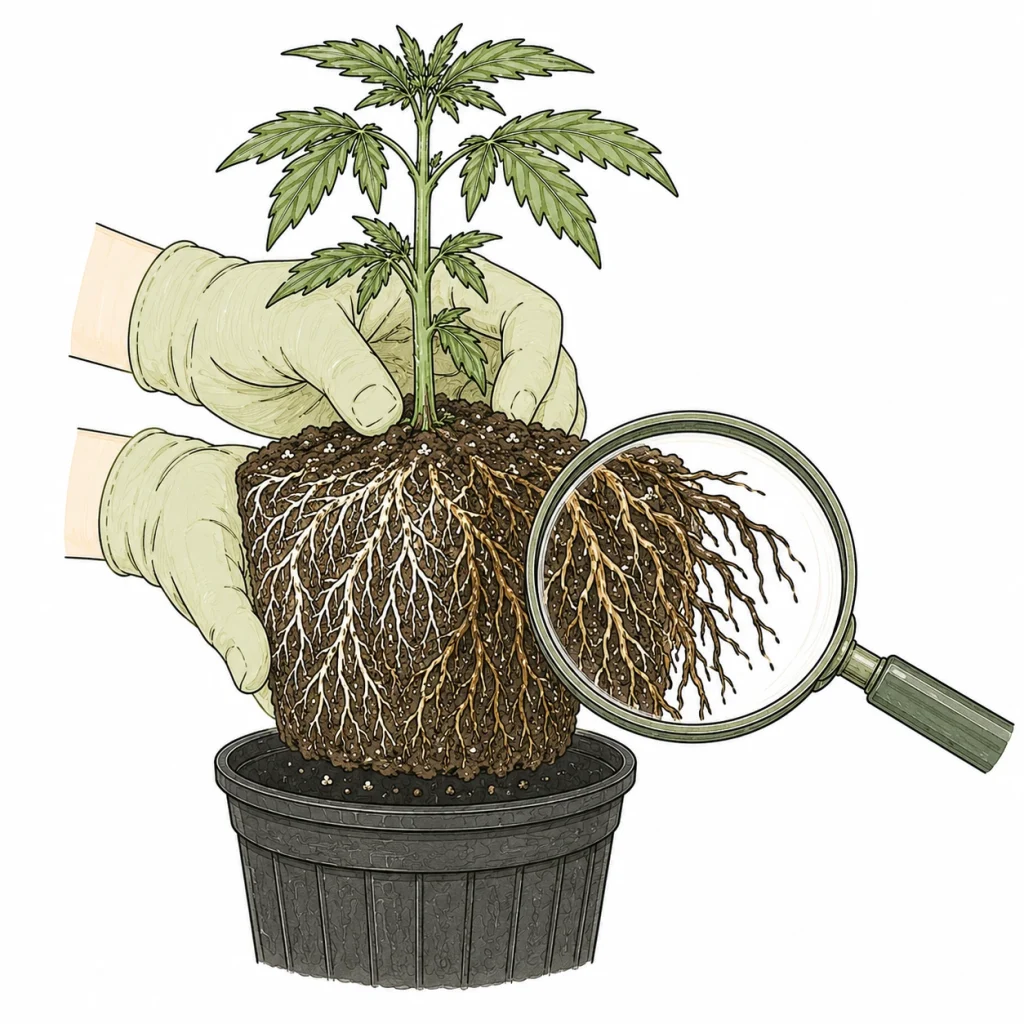
Cannabis root problems have more possible causes than most growers realize – and that’s exactly what makes them tricky. Wilting leaves, stalled growth and deficiencies even though you’re doing everything right can point to three completely different root problems: root rot caused by pythium, lack of oxygen from a compacted growing medium, or root bound plants stuck in a pot that’s too small. Treat the wrong cause and you can lose time and put your harvest at risk. In this guide from PlantClue, you’ll learn how to pin down the real root problem and fix each one the right way.
Why Cannabis Root Problems Are So Hard to Diagnose
The big problem with root damage is that you can’t see it directly. You look at your plant every day, but you hardly ever see its roots. Only growers using clear pots, fabric pots like Airpots or hydroponics setups can check root health on a regular basis. For everyone else, the root zone stays a black box until the symptoms on leaves, stems and shoots get so obvious that it’s clear you need to act.
On top of that, many cannabis symptoms have more than one possible cause. Yellow leaves can point to a deficiency, pH problems – or root damage. If you only treat what you see on top without fixing the cause down in the root zone, you end up fighting symptoms instead of the real problem. A wrong diagnosis leads to the wrong treatment – so real help starts with figuring out what you’re actually dealing with.
- Roots are out of sight and often get checked too late
- Symptoms on leaves and shoots can have many different causes
- Root problems can escalate fast if you leave them untreated
- Clear pots or hydroponics make early diagnosis much easier
- Identify the cause first, then treat – not the other way around
The Most Common Symptoms at a Glance
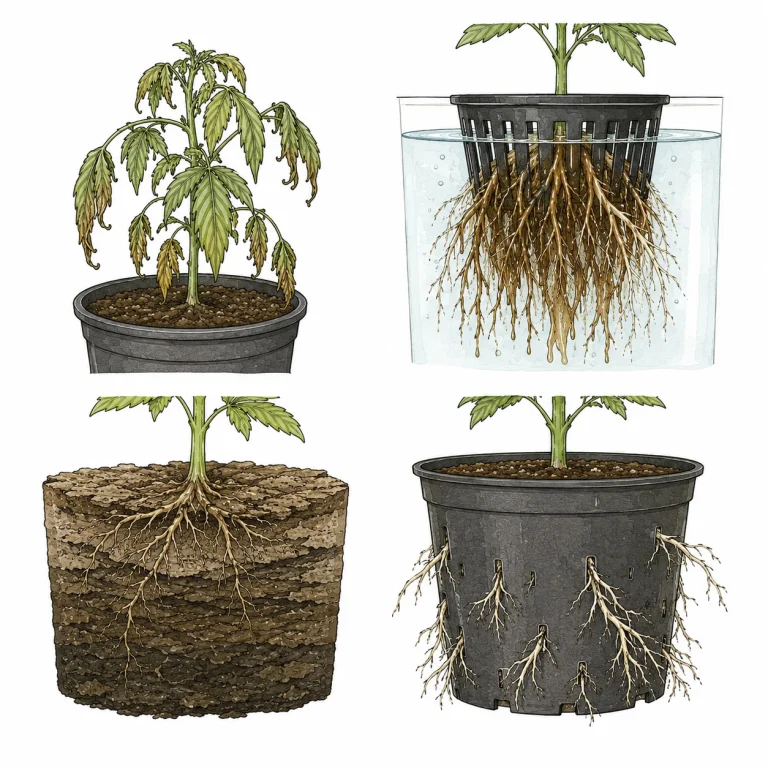
There are a handful of classic warning signs you should know. Wilting is one of the most common, and it’s often mistaken for underwatering: your plant droops even though you watered recently and the soil is still moist. That can be root rot, a lack of oxygen or overwatering – the symptoms look alike, but the causes are completely different. Just as typical is slow or completely stalled growth, even when light, temperature and feeding are dialed in.
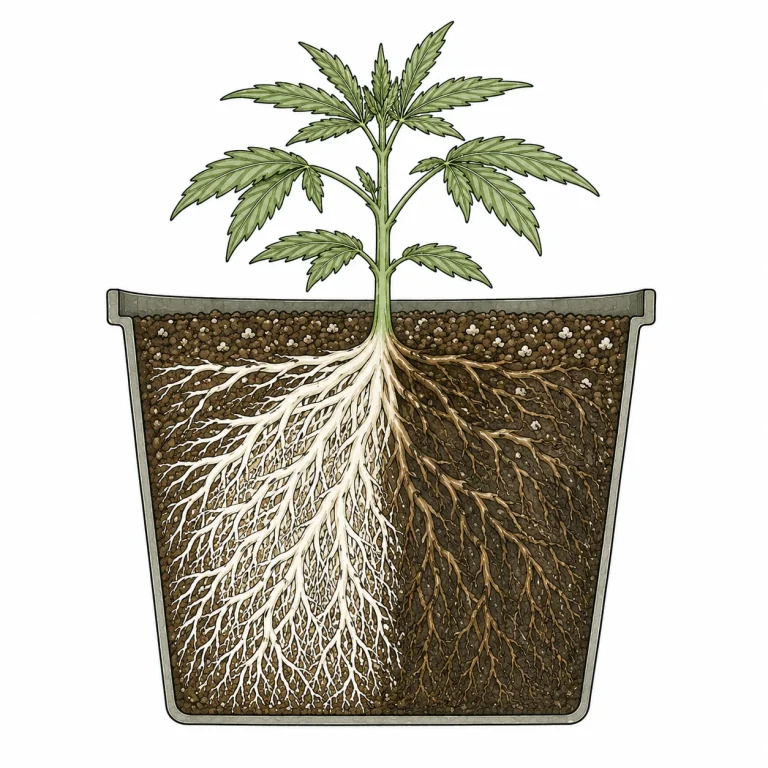
Deficiency symptoms that won’t clear up even though you’re feeding correctly often point to root problems. When roots are damaged, they can’t take up nutrients efficiently, even if there’s plenty available in the growing medium. Brown, slimy or foul-smelling roots are the clearest direct sign of root rot. Healthy cannabis roots are always white to cream-colored, firm and slightly fuzzy.
- Wilting despite moist soil: a sign of root rot, lack of oxygen or overwatering
- Growth stalls with no visible reason above the soil
- Deficiency symptoms that won’t go away even with proper feeding
- Brown, slimy or rotten-smelling roots
- Yellow leaves starting on the lower, older leaves
- The pot feels heavy and wet all the time, no matter when you watered
- Roots growing out of the drainage holes (a sign of being root bound)
Identifying the Causes of Cannabis Root Problems: Your Quick Diagnosis
Before you treat anything, figure out what you’re dealing with. This overview helps you narrow down the most likely problem based on your combination of symptoms:
| Main symptom | Additional sign | Likely cause |
|---|---|---|
| Wilting even though the soil is moist | Roots brown, slimy, rotten smell | Root rot (pythium) → Full guide |
| Wilting even though the soil is moist | Roots still white, no smell | Lack of oxygen / overwatering → Full guide |
| Growth stalls, pot dries out extremely fast | Roots poking out of the drainage holes | Root bound → Full guide |
| Deficiency signs even though you feed correctly | pH on point, roots damaged | Nutrient lockout from root damage → see section below |
Pythium root rot — the most dangerous root problem
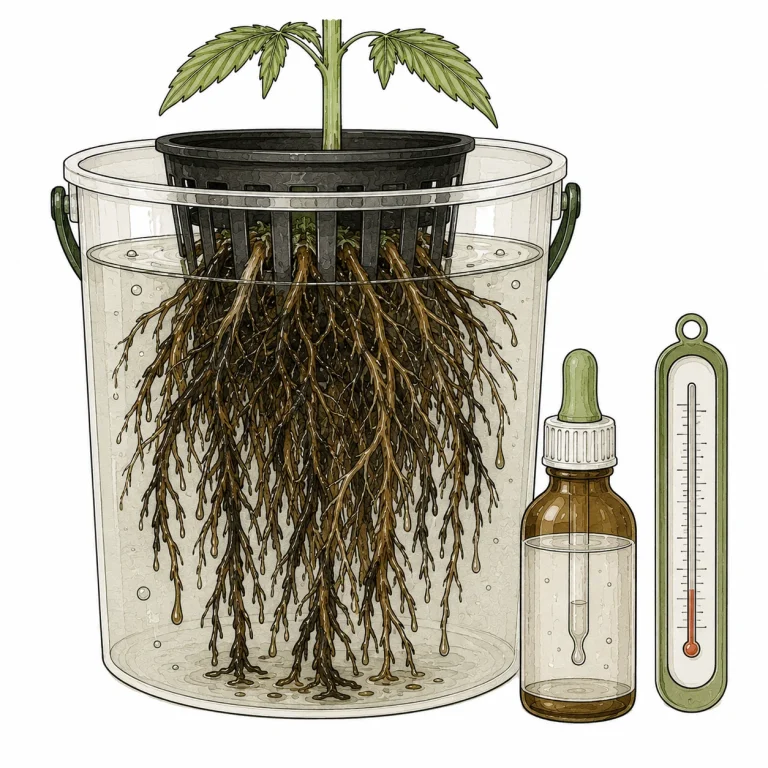
Root rot is the most dangerous of all root problems. It’s usually caused by the water mold pythium, and you can spot it easily: brown, slimy roots with a rotten smell. In a hydro system you see it right away. In soil, you need to gently slide the plant out of its pot to check. Want to know how to set up a clean DWC system? Our step-by-step guide shows you how. First aid: change the water and add 3% H₂O₂ (about 8–11 ml per gallon, or 2–3 ml per liter), and keep your water temperature below 68 °F (20 °C) at all times. Root rot can escalate fast and needs specific treatment steps, so we gave it its own in-depth guide:
→ Cannabis root rot: how to spot it, what causes it and how to save your plant
- Pythium water mold is the most common cause of root rot
- Easy to spot: brown, slimy roots with a rotten smell
- Hydro: change the water right away + add H₂O₂, keep it below 68 °F (20 °C)
- Full treatment plan: → How to spot cannabis root rot
Lack of oxygen and compacted growing medium: silent root killers
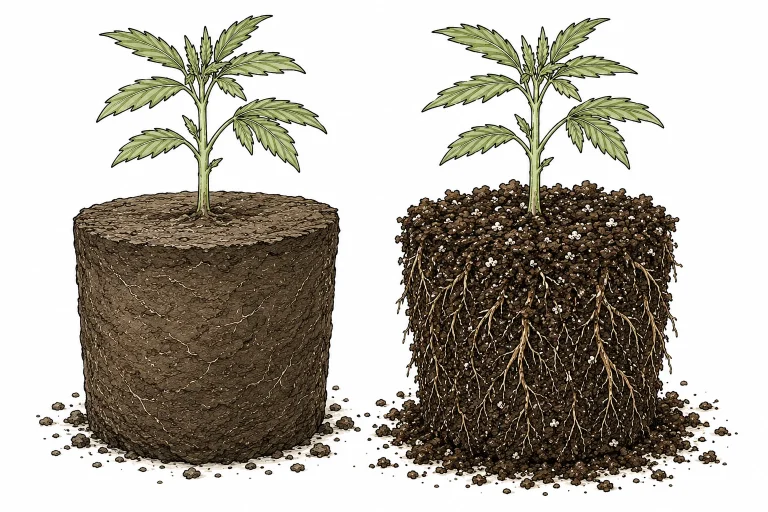
Besides pythium, a lack of oxygen in the root zone is one of the most common – and most overlooked – causes of root problems. Just like every other living thing, cannabis roots need oxygen to survive. In compacted medium, there are no air pockets, water can’t drain and the roots start to suffocate. The symptoms look a lot like overwatering: wilting, slow growth and deficiency signs even though you feed normally.
Compacted medium can come from low-quality soil, missing perlite or a similar amendment to keep it airy, pressure from poking around in it too often – or simply its own weight over time. A good cannabis growing medium should be loose, drain well and be rich in organic matter. Mixing in 20–30% perlite is one of the easiest and most effective ways to improve your root zone. Already dealing with compacted medium? Carefully poke a few holes into the soil with a bamboo stake to improve aeration without hurting the roots.
The pH of your water and growing medium also plays a key role in root health. The wrong pH blocks nutrient uptake at the root tips. That leads to deficiency symptoms that often get mistaken for feeding mistakes. Learn more in our article on how to adjust pH for cannabis. For cannabis in soil, aim for a pH between 6.0 and 7.0. For hydroponics, aim for 5.5 to 6.5.
- Roots need oxygen and can suffocate in compacted growing medium
- Mix in 20–30 percent perlite for great aeration
- Use bamboo sticks to gently loosen the medium without damaging roots (helps prevent waterlogging)
- pH outside the ideal range blocks nutrient uptake at the roots
- Soil: pH 6.0–7.0; hydroponics: pH 5.5–6.5
- Choose a quality growing medium with good drainage
Root Bound: When Your Pot Gets Too Small for the Roots
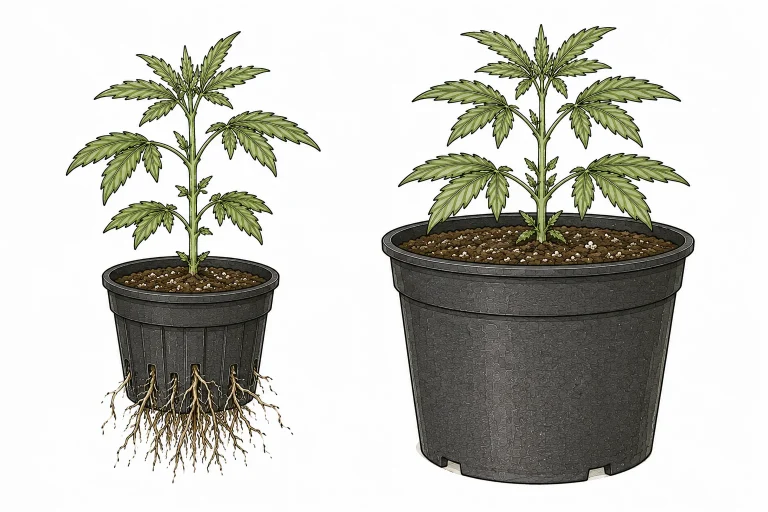
One often underestimated cause of cannabis root problems is being root bound — and the fix is usually simple: transplant in time. Root bound means your plant is literally trapped in its pot because the roots have no more room to grow. The roots start circling around the bottom of the pot, get matted and begin to strangle each other. Growth above the soil stalls, even though light, nutrients and water are all there. You can often spot it when roots poke out of the drainage holes, water runs through the pot very fast and the soil dries out extremely quickly.
The fix is transplanting into a much bigger container. Rule of thumb: in the vegetative stage, move up to a pot at least twice the size of the current one about every two to three weeks. For full-grown indoor cannabis plants, pots of at least 3 to 5 gal (11 to 20 L) are usually recommended, depending on the strain and how big you want the plant to get. Go gently when you transplant so you don’t damage the root ball: hold the stem close to the soil, flip the pot upside down and tap it lightly until the root ball slides out.
If you’re also fighting nutrient problems, check whether nutrient burn in the small pot has caused salt buildup that stresses the roots even more. In that case, a thorough flushing of the growing medium before transplanting can make sense.
- Roots coming out of the drainage holes are a clear sign of root bound
- Growing medium dries out extremely fast despite normal conditions
- Growth stalls even though everything above the soil looks well supplied
- Transplant into a container at least twice as big
- Veg: move up to a bigger pot every 2–3 weeks
- Indoor plants need a pot size of at least 3–5 gal (11–20 L)
How to Tell Root Damage from Real Nutrient Problems
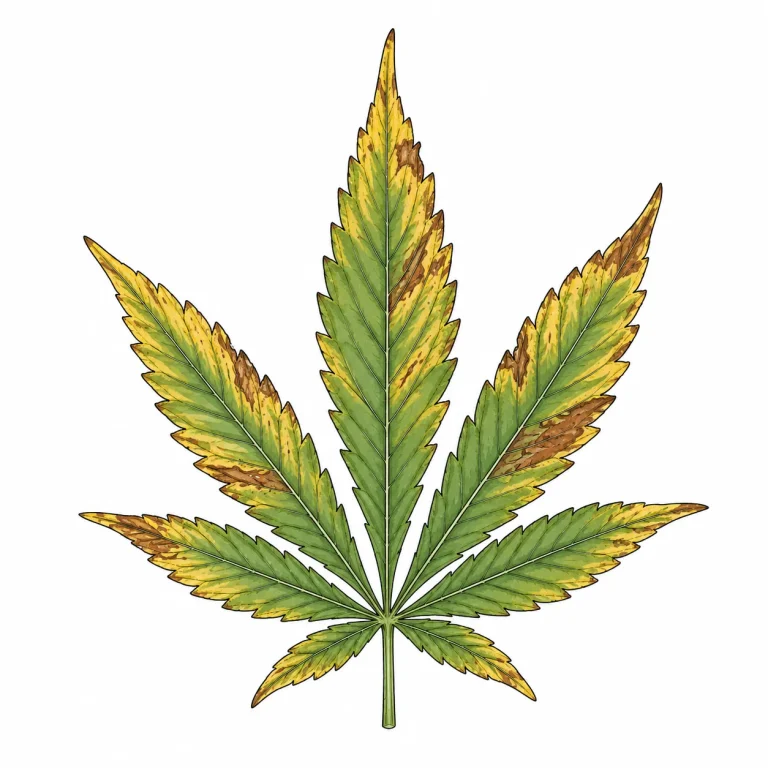
One of the most common mistakes when diagnosing cannabis problems is treating a nutrient deficiency when the roots are the real issue. The logic is simple: if the roots are damaged by rot, lack of oxygen or compaction, they can’t take up nutrients efficiently. Your plant then shows the exact same symptoms as a true deficiency, even though the soil is well fed. Signs of calcium and magnesium deficiency, like brown leaf edges, leaf spots and necrosis, can be a direct result of root damage.
If you simply feed more in this situation, you’ll usually make things a lot worse. More nutrient salts in the medium raise the osmotic pressure and can put even more strain on roots that are already weak. The right approach: fix the root problem first, then bring feeding back to normal. After a root repair, always start at half-strength nutrients and ramp up slowly so you don’t overload the recovering roots. Learn more about diagnosing symptoms the right way in our article on causes of yellow cannabis leaves.
Calcium is especially important for cell division in the root tips. A calcium deficiency and poor root development can feed each other in a vicious cycle. If you see signs of calcium deficiency and your pH is on point, take a look at the root zone. For treatment details, check out our guide on how to fix calcium deficiency in cannabis.
- Deficiency symptoms can be caused by root damage
- Adding more nutrients to a plant with root problems can make things worse
- Once the roots have recovered, restart feeding at half strength
- Calcium deficiency and weak roots feed each other
- Fix the roots first, then bring feeding back to normal
- Check your pH before you diagnose a nutrient deficiency
Prevention Is Your Best Defense Against Cannabis Root Problems
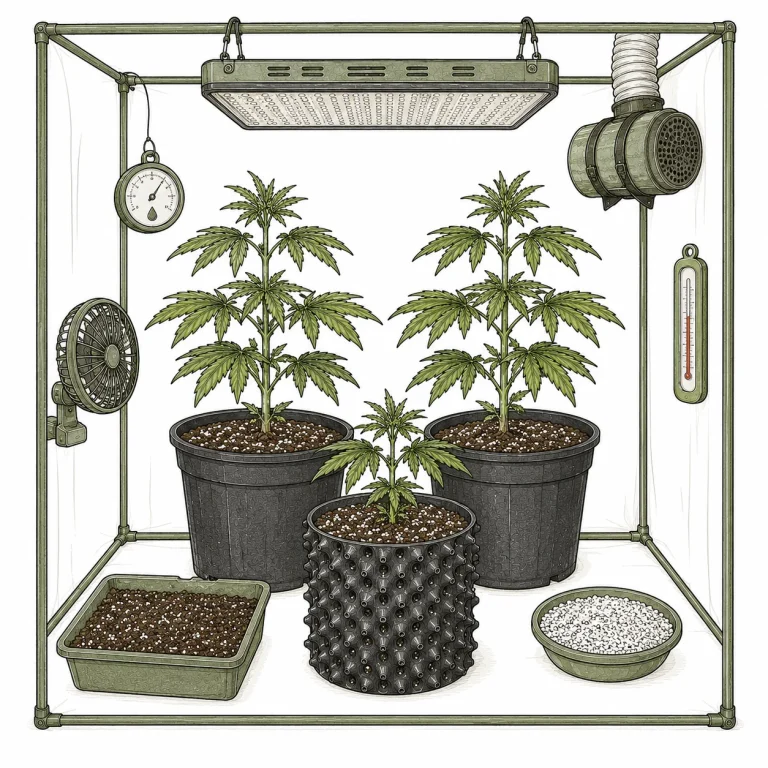
The best way to deal with root problems is to avoid them from the start. That begins with picking the right growing medium. Use a quality soil made for cannabis, or mix regular potting soil with 20–30% perlite for great drainage and aeration. Pots with plenty of drainage holes, plus maybe a layer of clay pebbles (LECA) at the bottom, help water drain even better. For more advanced growers, air pots or fabric pots are an excellent choice. Their porous walls air-prune the roots naturally and largely prevent your plants from getting root-bound.
Hygiene is the second key part of prevention. Sterilize pots, tools and surfaces regularly. Don’t carry contaminated water from one system into another. In hydroponics (hydro), regular cleaning of the reservoir and all lines is crucial. Use beneficial microbes like trichoderma, mycorrhizal fungi (mycorrhizae) and Bacillus subtilis as a biological shield for your roots – these natural allies actively compete against pythium and other pathogens. For a complete walkthrough of the ideal indoor setup, see our cannabis indoor grow guide.
Your watering habits are the third pillar of root care. Water on a wet-dry cycle: wait until the pot has dried down to about 80% of its fully watered weight before you water again. Lift the pot to judge its weight. Overwatering is by far the most common self-inflicted cause of root problems. Learn more in our article on how to water cannabis the right way.
- Quality growing medium with 20–30% perlite for great drainage
- Fabric pots and air pots prevent root-bound plants and improve aeration
- Trichoderma and mycorrhizal fungi as biological protection against pathogens
- Stick to the wet-dry cycle: let the pot dry down to 80% of its weight before watering
- Keep the root zone below 75 °F (24 °C)
- Sterilize all gear and containers regularly
If growth still stalls even though the roots are healthy, something else may be going on – read more in our article on stunted growth.
Frequently Asked Questions
How Can I Spot Root Rot in Cannabis Grown in Soil?
Root rot is harder to spot in soil than in hydro systems. Typical indirect signs: wilting even though the soil is moist, stalled growth, and deficiency symptoms that don’t improve even with proper feeding. You can see root rot directly when you carefully lift the plant out of its pot. Healthy roots are white and firm. Rotting roots are brown to black, slimy and smell foul. You’ll find every treatment step in our in-depth guide: how to identify and treat cannabis root rot.
What’s the Difference Between Overwatering and Root Rot?
Overwatering is often the cause, root rot the result. With plain overwatering, the roots are still white and intact but are starved of oxygen. If the overwatering continues, pathogens like pythium can move in and cause true root rot. The telltale difference: with root rot, the roots smell clearly rotten and turn brown to black, while overwatered but still healthy roots stay white. For overwatering, start with a wet-dry cycle – learn more in our article Overwatered cannabis – what to do?
How Often Should I Check My Cannabis Plant’s Roots?
In hydroponic systems, check the roots every time you change the water, so roughly once a week. If you grow in soil or coco, transplanting is a good time to check, about every two to four weeks during the vegetative stage. If you notice wilting, stalled growth or a nutrient deficiency you can’t explain, check the roots right away. Clear pots let you watch the roots all the time without pulling the plant out of its pot.
What pot size prevents root-bound cannabis plants?
Rule of thumb: plan on at least 2.6 gal (10 L) of pot volume for every 12 in (30 cm) of plant height. For an average indoor plant in flower, 3 to 5 gal (11 to 20 L) is ideal. Autoflowering strains often get by with 2 to 3 gal (7 to 11 L). Fabric pots and air pots are great choices. Air pruning stops roots from circling along the pot wall, so getting root bound becomes very unlikely. Check regularly whether roots are growing out of the drainage holes. That’s the clearest sign it’s time to transplant.
You’ll find fabric pots that keep roots healthy on our Recommended Gear page.
The Bottom Line
You can fix cannabis root problems, but only once you know the real cause. Root rot, lack of oxygen and root-bound plants show similar symptoms, yet each one needs a completely different fix. The quick diagnosis in this guide helps you pin down your specific problem and act on it. Prevention is still your best protection: water wisely, use a quality growing medium and transplant on time. The sooner you act, the better your chances of a full recovery and a good harvest.
