

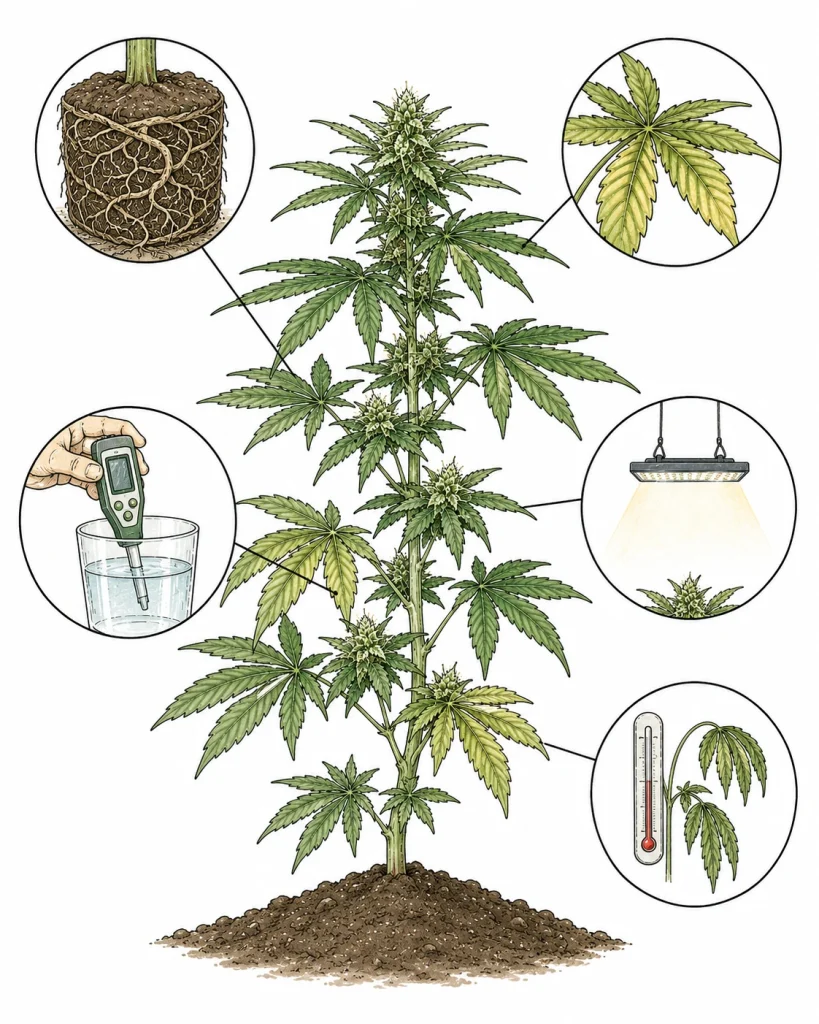
When cannabis growth stalls, many growers stand in front of their plant at a loss, not knowing where to start looking. The good news: in most cases, there’s a manageable cause behind it that you can fix quickly with the right know-how. From nutrient deficiencies to root problems to the wrong environmental conditions, there are clear patterns you can learn to read. In this article, we walk you step by step through the most common causes and show you how to get your plant back on track.
Cannabis plant not growing: the most common causes at a glance
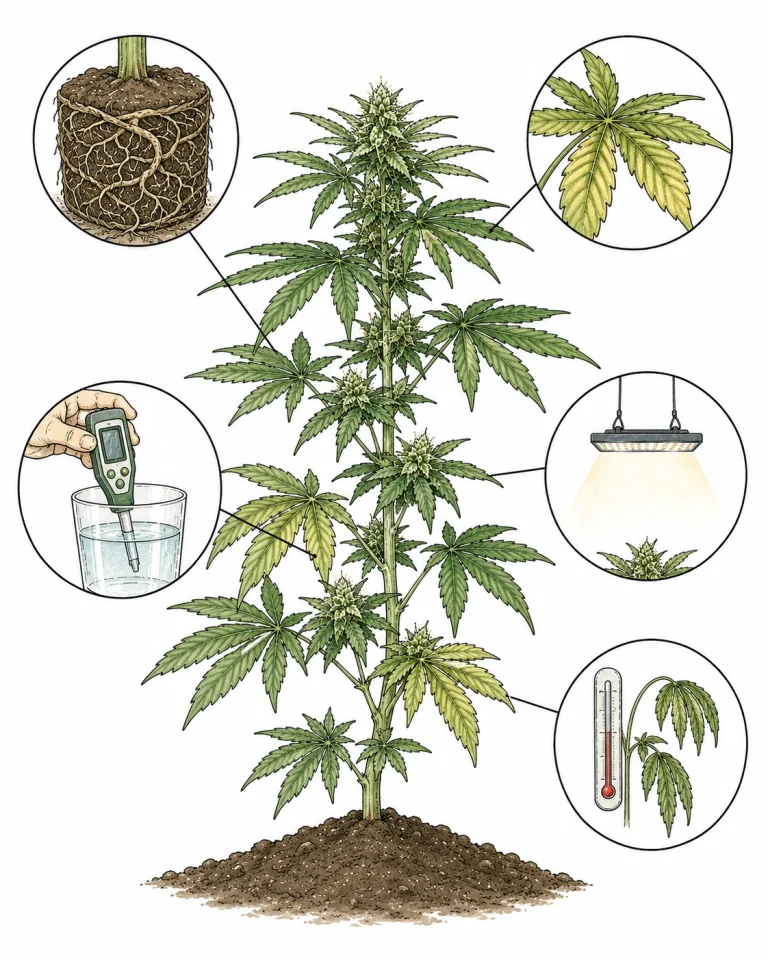
When cannabis growth stalls, it’s important to work through it systematically instead of experimenting blindly. Your plant is sending you signals – you need to learn to read them correctly. The most common triggers fall into five main categories: root problems, nutrient supply, pH problems, lack of light, and temperature and humidity stress.
What makes it especially tricky is that many of these problems look similar. The plant looks small, doesn’t put out new leaves, the internodes barely stretch, and the overall impression is simply “frozen.” Sometimes the cause isn’t one single thing but a combination of several unfavorable factors. That’s why it makes sense to check every area one after the other.
One often overlooked factor is transplant shock after repotting. The plant then puts all its energy into root growth and shows hardly any progress above ground. That’s normal and no reason to panic – as long as it doesn’t last longer than one to two weeks. If the standstill lasts longer, you should dig deeper into the diagnosis.
- Root-bound plant in a pot that’s too small
- Soil pH outside the optimal range of 6.0 to 7.0
- Nutrient deficiency or nutrient lockout caused by the wrong pH
- Too little or too much light
- Temperature below 64 °F (18 °C) or above 86 °F (30 °C)
- Overwatering or underwatering
- Transplant shock after repotting
- Root rot from a constantly moist growing medium
pH: the most common cause when cannabis growth stalls
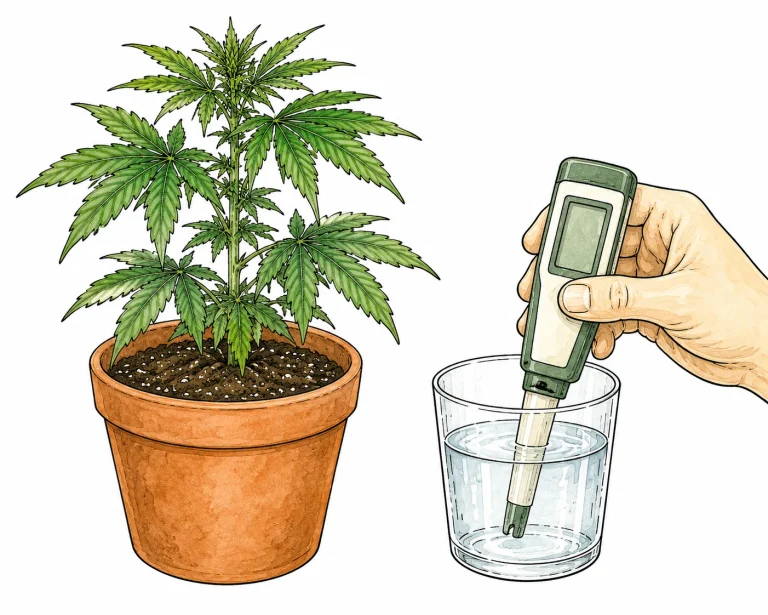
In the experience of many seasoned growers, pH is the number-one cause when cannabis growth stalls. The wrong pH blocks nutrient uptake at the roots, even if you’ve fed enough. In soil, the pH should be between 6.0 and 7.0, ideally around 6.2 to 6.8. In hydroponic systems the optimal range is narrower: 5.5 to 6.2.
If the pH stays too low or too high, certain nutrients can no longer be taken up – this is called nutrient lockout. The plant literally starves even though there would be enough nutrients available. The result is stalled growth that doesn’t improve no matter how much you feed. So always measure both the pH of your water and the pH of the water that drains out (runoff).
Once you correct the pH, you’ll often see the first improvements within a few days. The plant starts putting out new leaves again, and growth returns to normal. It’s important not to change the pH too abruptly but to adjust it gradually. You’ll find a detailed guide in our article on how to adjust the pH for cannabis correctly.
- Optimal soil pH: 6.0 to 7.0 (ideally 6.2 to 6.8)
- Optimal hydro pH: 5.5 to 6.2
- pH below 5.5 locks out calcium, magnesium and phosphorus
- pH above 7.0 locks out iron, manganese and zinc
- Always measure the runoff pH, not just your water
- Correct gradually by no more than 0.5 pH units per watering
Root problems and overwatering: when the foundation is sick
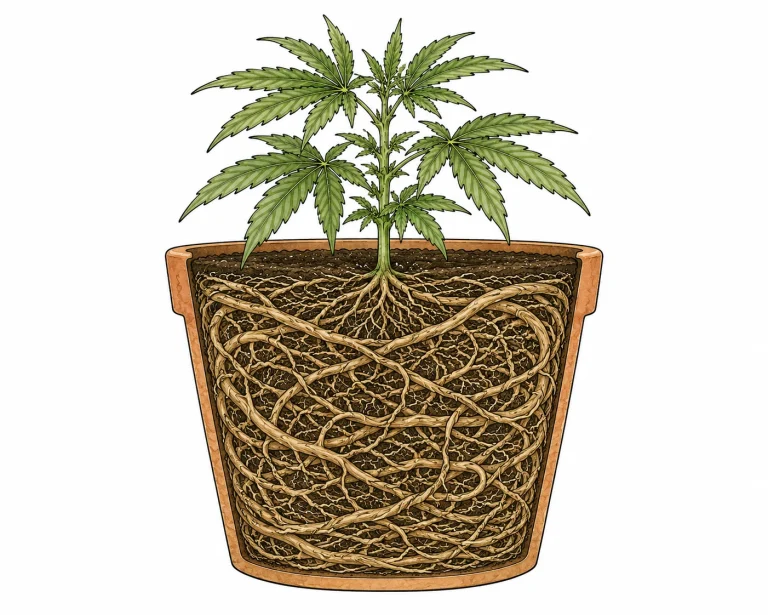
Healthy roots are the foundation for healthy growth. When your plant is stuck in a pot that’s too small and the roots are crowding each other out, it’s called being “root-bound.” In this state, the plant can barely take up water and nutrients, and growth grinds to a halt. An early sign is often that the growing medium dries out again very quickly after watering.
The opposite problem is at least as common: overwatering. When the growing medium is constantly too wet, hardly any oxygen can reach the roots. The result is oxygen deprivation at the roots and, in the worst case, root rot – what you can do about it is covered in our article Overwatered cannabis: what to do. The plant reacts with drooping leaves that don’t recover even after watering, and growth stops completely. You can learn more about watering properly in our guide on how to water cannabis properly.
The rule of thumb for the right watering rhythm: push your finger about 2 in (5 cm) into the growing medium. If it still feels moist, wait another day. If it feels dry, it’s time to water. If the pot is too small, the only fix is transplanting into a bigger container. As a guideline: a pot of 0.8 to 1.8 gal (3 to 7 L) is enough in the vegetative stage, and in flowering it should hold up to 2.9 gal (11 L).
- Root-bound: the pot is too small and the roots grow in circles
- Sign of being root-bound: the growing medium dries out extremely fast
- Overwatering: growing medium constantly wet, leaves droop
- Underwatering: growing medium bone-dry, leaves wilt
- Finger test: push your finger 2 in (5 cm) into the growing medium
- Fix for root-bound plants: transplant into a pot at least twice the size
- Root rot: brown, slimy roots and a rotten smell – more in our article on causes of cannabis root problems
Nutrient deficiencies as a growth brake: what your plant is missing
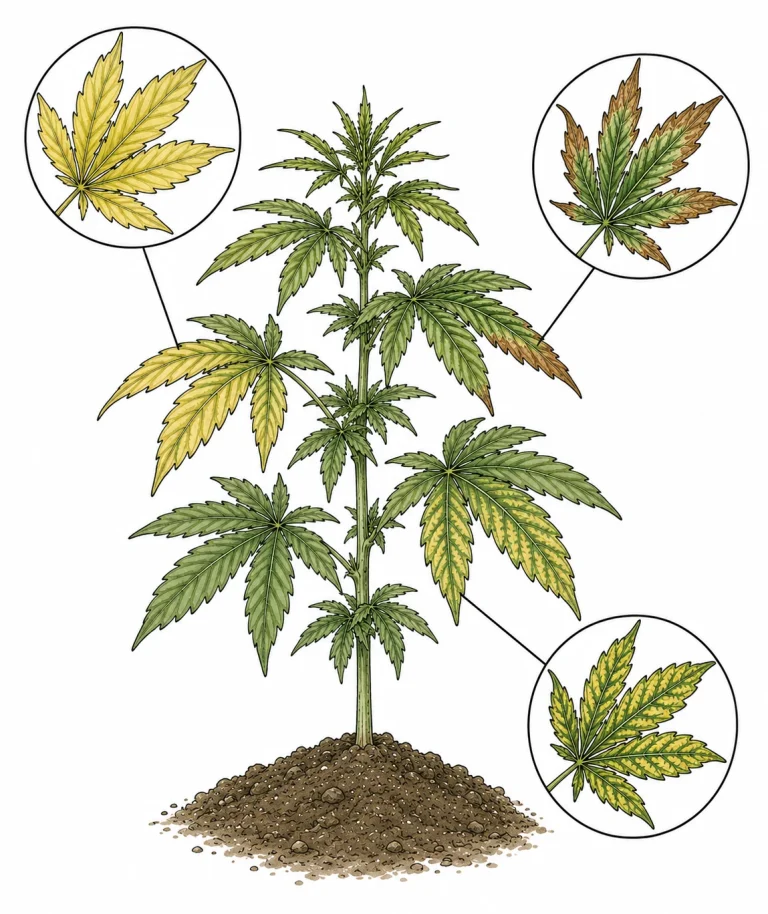
Nutrient deficiencies are one of the most common causes when cannabis growth stalls. The three most important macronutrients for the vegetative stage are nitrogen (N), phosphorus (P) and potassium (K) – known as NPK. Nitrogen is the most important nutrient for lush leaf growth. If it’s missing, the plant first shows yellowing on the lower, older leaves, and overall growth slows down noticeably.
But secondary nutrients like calcium and magnesium also play an important role. Calcium deficiency in cannabis often shows up as brown spots on the leaves and brittle stems, along with slower growth. Magnesium deficiency, on the other hand, causes a characteristic interveinal chlorosis – the leaf tissue between the veins turns yellow while the veins themselves stay green. Both deficiencies are especially common when the pH is off.
Good to know: not every nutrient deficiency is caused by feeding too little. Very often, the wrong pH is the real culprit, blocking nutrient uptake. So before you feed more, check your pH first. Overfeeding can make the problem even worse. You can learn more in our article on how to spot and fix cannabis nutrient burn.
- Nitrogen deficiency: yellowing of the lower leaves, slower growth
- Phosphorus deficiency: dark green to purple discoloration of the leaves
- Potassium deficiency: brown leaf edges, especially on older leaves
- Calcium deficiency: brown spots, brittle stems, stalled growth
- Magnesium deficiency: yellow leaf tissue between green veins
- Check the cause: often a pH problem, not really a lack of nutrients
- Fix: check the pH first, then adjust feeding
Light, temperature and humidity: environmental factors that stop growth
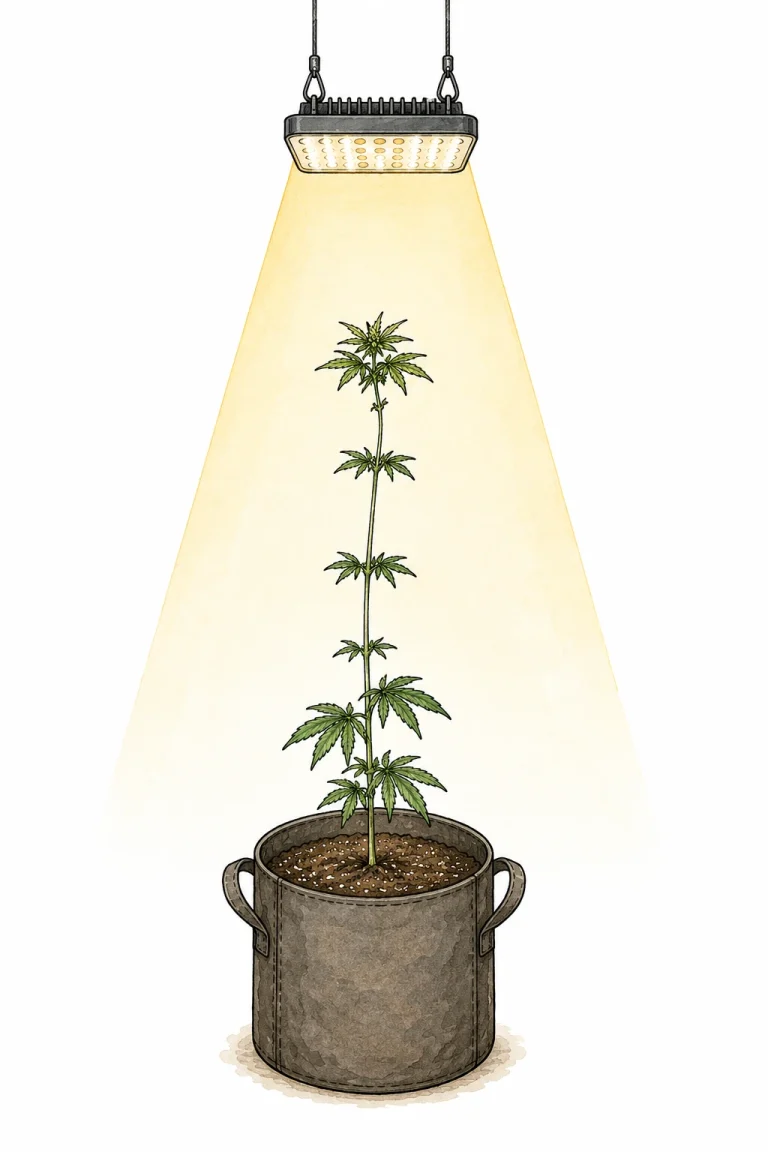
Even if nutrients and pH are perfect, your cannabis plant won’t grow without enough light. For indoor growing, at least 18 hours of light per day are recommended in the vegetative stage. If the light intensity is too low or the lamp is too far away, the plant reacts with excessive stretching (etiolation) and slower growth. Guideline for LED lights in veg: about 400 to 600 µmol/m²/s PPFD (photosynthetic photon flux density).
Temperature and humidity are often underestimated. Cannabis grows best at daytime temperatures between 72 and 82 °F (22 and 28 °C). Below 64 °F (18 °C), the metabolism slows down considerably, and growth can come almost to a complete stop. Above 86 °F (30 °C), the plant goes into heat stress, which also stops growth. The ideal humidity in the vegetative stage is 50 to 70 percent.
Another often forgotten factor is the CO2 level in the air. Plants need CO2 for photosynthesis. In poorly ventilated rooms, the CO2 level drops well below the normal atmospheric level of about 400 ppm, which slows growth considerably. Good ventilation with fresh air is therefore essential. Make sure your intake and exhaust are set up properly in your grow room.
- Light cycle in veg: 18 hours of light, 6 hours of darkness
- Optimal temperature: 72 to 82 °F (22 to 28 °C), never below 64 °F (18 °C) or above 86 °F (30 °C)
- Optimal humidity in veg: 50 to 70 percent
- LED too close: light burn, growth stops
- LED too far away: etiolation, weak growth
- Lack of CO2 from poor ventilation slows photosynthesis
- Nighttime temperature drops of more than 18 °F (10 °C) cause stress
Growing medium and pot size: the invisible growth brakes
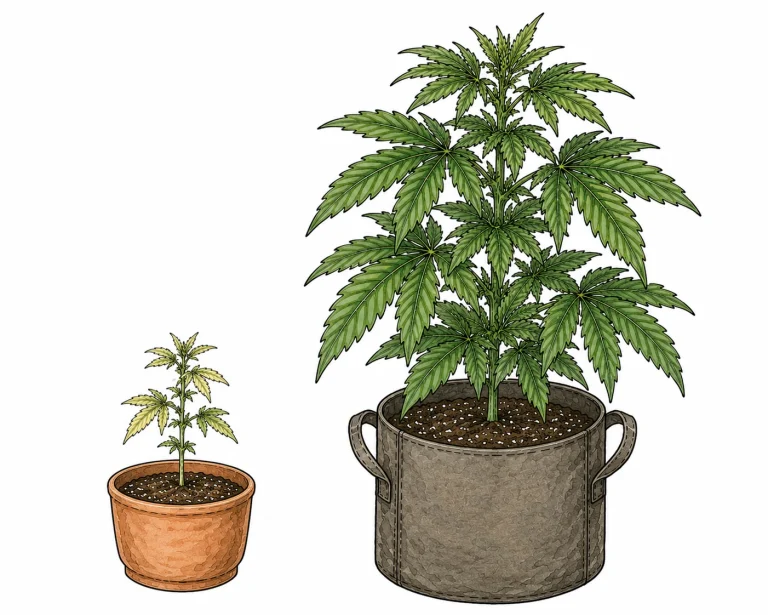
The growing medium is your plant’s foundation. A growing medium that’s too compacted, low in nutrients or poorly mixed can slow growth just as much as a nutrient deficiency or pH problems. High-quality cannabis soil has a loose, airy structure that holds water well but also drains off the excess easily. Too much clay or loam makes the growing medium too heavy and compacts it over time.
Perlite is an important soil amendment you should definitely know about. Adding 20 to 30 percent perlite to your soil greatly improves drainage and gets more oxygen to the roots. If you start with fresh soil that already contains nutrients (so-called “hot soil”), seedlings can get nutrient burn, which slows down early growth.
Pot size has a direct impact on the plant’s growth potential. As a rule of thumb: a plant grows as big as its pot allows. Pots that are too small lead to root-bound plants, while pots that are too big for small plants increase the risk of overwatering because the soil dries too slowly. When transplanting, always go by the current size of your plant.
- Ideal growing medium: loose, airy, well-draining
- Perlite share: 20 to 30 percent for better drainage
- Overly compacted growing medium restricts root growth and nutrient uptake
- Hot soil with lots of nutrients can burn seedlings
- Pot size in veg: 0.8 to 1.3 gal (3 to 5 L) for small plants, 2.9+ gal (11+ L) for large ones
- A pot that’s too big for a small plant increases the risk of overwatering
- Best time to transplant: when the bottom layer is almost dry
Cannabis plant not growing: telling the causes apart by growth stage
The most likely cause depends heavily on which stage your plant is in. A stalled seedling needs a different diagnosis than a plant in flowering.
- Seedling: Here, stalling often shows up as leggy, stretched growth from lack of light or as the seedling falling over completely due to damping-off. At this stage, the plant is most sensitive to overwatering and the wrong temperature.
- Vegetative stage: Stalling is usually caused by cramped roots (a pot that’s too small), pH lockout or a nutrient deficiency that only becomes noticeable after several weeks of growth. Check the pH and pot size first here.
- Flowering stage: A sudden growth stop in flowering is often normal (the plant puts its energy into building buds instead of growing taller), but it can also point to an acute nutrient deficiency or heat stress. A slight slowdown is no cause for alarm here, but a complete standstill combined with yellowing is.
How fast does cannabis normally grow? Benchmarks by stage
Before you assume a real growth stall, it’s worth comparing your plant with typical benchmarks. Every stage has its own pace, and not every slowdown is a warning sign.
- Seedling (day 0–14): In the first two weeks, cannabis seedlings grow only a fraction of an inch (a few millimeters) per day and mainly build roots and their first true leaf pairs. Visible height gain stays minimal here – that’s normal.
- Early vegetative stage (around week 3–4): Now the plant should gain noticeable height, often 0.4–0.8 in (1–2 cm) per day under good light. If a 3- to 4-week-old plant stays clearly smaller than a hand’s width and shows no new leaf pairs, that points to one of the causes described below.
- Late vegetative stage (from week 5): Once the root system is established, photoperiod strains often speed up to 0.8–2 in (2–5 cm) per day, while autoflowers usually grow a bit more evenly and moderately.
- Flowering stage: After the initial flowering stretch, height growth slows down on purpose – the plant puts its energy into building buds instead of growing taller.
If your plant is clearly below these benchmarks for its current stage, the best approach is to work through the following causes systematically.
Cannabis plant not growing: step-by-step diagnosis and immediate fixes
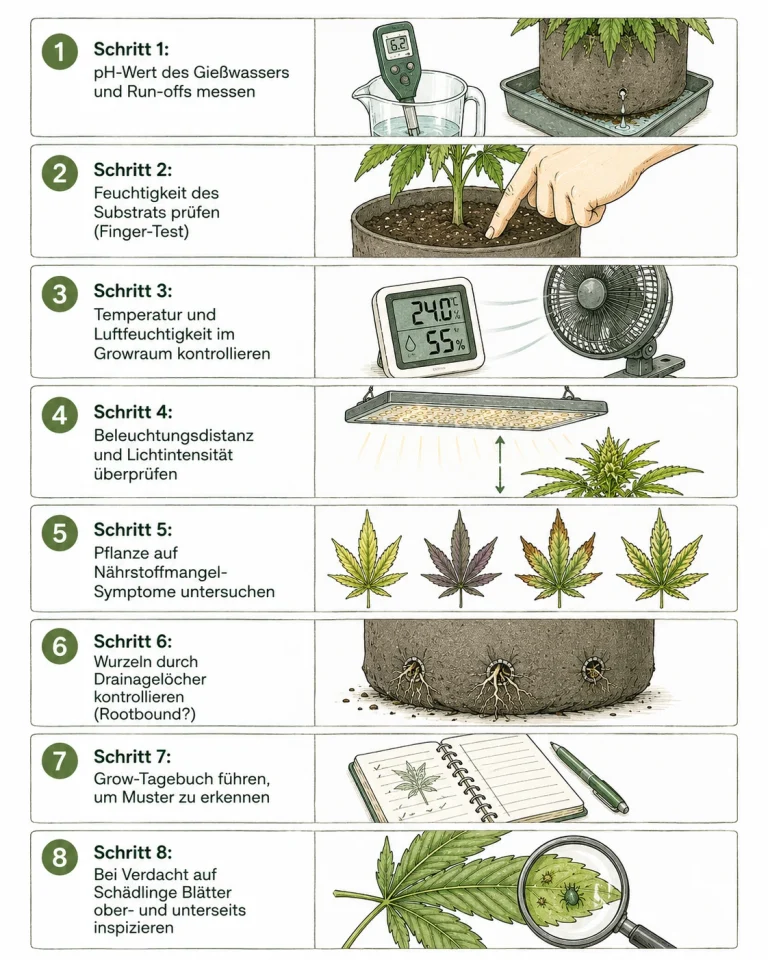
When your cannabis growth stalls, take a structured approach. Always start with the basics: When did you last water? What’s your pH? How old is the growing medium? These three questions already cover the most common causes. Then measure the temperature in your grow room and check your lighting setup as well. Often, correcting just one of these factors is enough to get growth going again.
Keep a simple grow journal where you record daily observations, pH readings, watering amounts and temperatures. This log helps you spot patterns and react to problems faster. When you can look back over several weeks, you’ll often be able to pinpoint exactly when growth slowed down – and what changed at that time.
For a complete overview of all possible cannabis problems and their solutions, we recommend our Plant Diagnosis overview on PlantClue. There you’ll find in-depth articles on every specific problem, sorted by symptom and cause. If you’ve checked and corrected all the basic factors and growth still doesn’t kick in, it could be a pest or disease problem that you should rule out with a more thorough inspection of the plant and soil.
- Step 1: Measure the pH of your water and runoff
- Step 2: Check the moisture of the growing medium (finger test)
- Step 3: Check temperature and humidity in the grow room
- Step 4: Check the light distance and light intensity
- Step 5: Inspect the plant for nutrient deficiency symptoms
- Step 6: Check the roots through the drainage holes (root-bound?)
- Step 7: Keep a grow journal to spot patterns
- Step 8: If you suspect pests, inspect the tops and undersides of the leaves
If the stalled growth affects a young plant, also read our article on seedling problems.
Frequently Asked Questions
How long can cannabis growth stall before I step in?
If your plant barely grows for one to two weeks after transplanting, that’s normal and usually transplant shock. If growth stays stalled for more than two weeks without an obvious reason like transplanting, you should actively look for the problem and check the pH, watering and environmental conditions.
Can nutrient burn cause cannabis growth to stall?
Yes, overfeeding can slow growth just as much as a nutrient deficiency. Too many nutrients raise the salt concentration in the growing medium and can cause osmotic stress, where the roots can no longer take up water. This is called nutrient burn. In that case, flush the growing medium thoroughly with pH-adjusted water.
Does cannabis grow more slowly in winter?
Outdoors, yes; indoors, usually not, as long as the ambient temperature is controlled. In winter, though, cold nights can make the temperature in your grow room drop below the optimal range, especially if the room is poorly insulated. Check the nighttime temperature and make sure it doesn’t fall below 64 °F (18 °C).
Does extra CO2 help when cannabis growth stalls?
CO2 supplementation can speed up growth, but it only makes sense once all other factors are already dialed in. If your grow room is poorly ventilated, make sure there’s enough fresh air first. Enriching CO2 to 1,000 to 1,500 ppm only really pays off in professional setups with optimal lighting, temperature and nutrient supply.
My plant is growing downward (drooping leaves) instead of up. What should I do?
Drooping leaves are usually a sign of overwatering or root problems. Let the growing medium dry out well and check the drainage. If the leaves droop even though the growing medium is dry, root rot could be the cause. Check the roots for brown discoloration and a rotten smell, and act quickly if you find them.
Can I save a cannabis plant that hasn’t grown in weeks?
In most cases, yes, as long as the roots are still healthy and there’s no severe disease. First identify the cause and fix it specifically. After the correction, give the plant one to two weeks to recover. If you still don’t see any improvement after that, check all the factors again or reach out to our diagnosis community.
Why is my cannabis plant growing so slowly?
Slow growth almost always has the same causes as a complete growth stop, just less pronounced: a slightly off pH, too little light, cool temperatures below 68 °F (20 °C) or the beginnings of a nutrient deficiency. pH and light distance are the most common brakes, so check these two points first. Measure the pH of your water and make sure your lamp is hanging close enough to the plant. If growth stays noticeably slower than expected for several weeks, go through all the causes above systematically instead of changing just one factor.
Conclusion
When cannabis growth stalls, the solution almost always lies in one of the classic causes: the wrong pH, watering mistakes, nutrient problems, unsuitable environmental conditions or pot problems. With a systematic approach to diagnosis, you can usually narrow down and fix the problem quickly. Keep a grow journal, measure your pH regularly and check on your plant every day – that way, you’ll catch problems early before they cause serious damage. The faster you react, the better your chances of saving your plant and bringing in a healthy harvest.
