

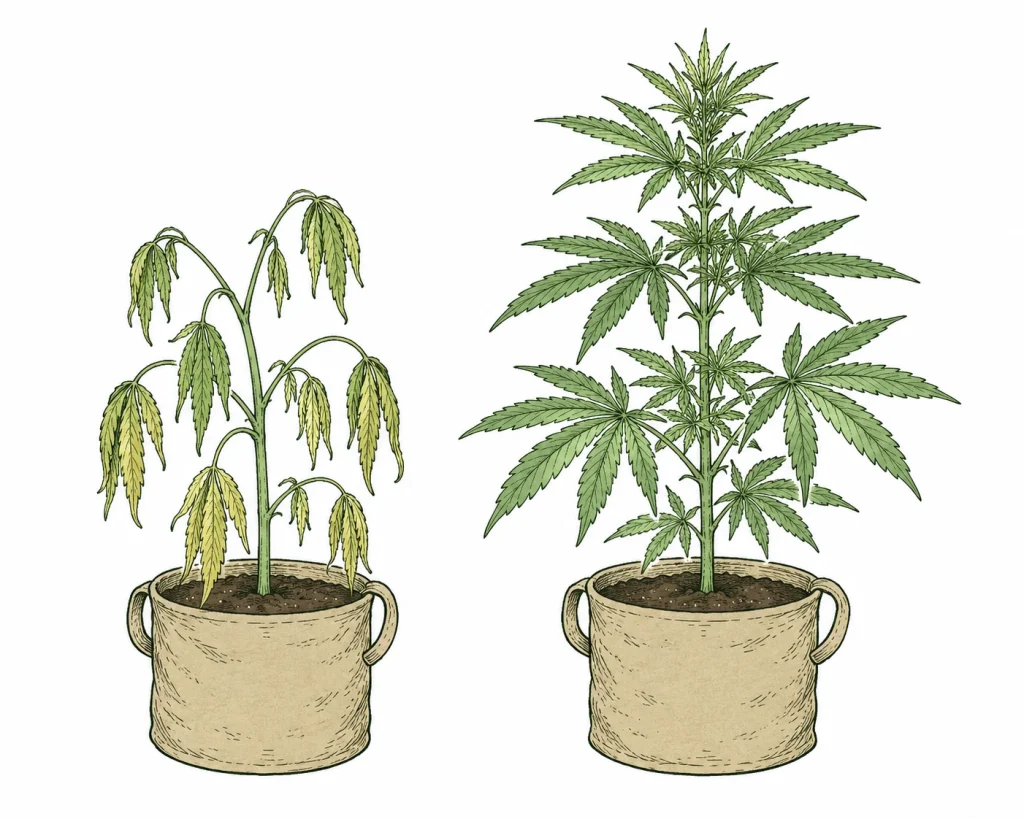
Saving wilting cannabis plants is one of the most common emergencies in any grow, whether you grow indoors or outdoors. Droopy, limp leaves are a clear warning sign from your plant: something is off with the water supply, the temperature or the root system. The good news is that in most cases you can act fast and still save your plant, as long as you pin down the right cause. In this article you get a complete diagnosis overview, clear first-aid steps and long-term prevention strategies, so your plants can stand tall and healthy again.
How to read the symptoms of wilting cannabis plants
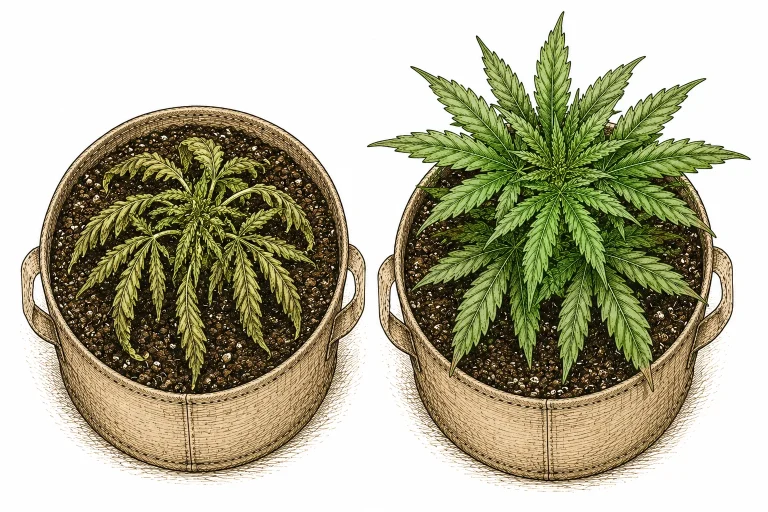
Before you start treating anything, you need to understand what wilting cannabis plants are actually telling you. Wilting isn’t a problem on its own. It’s always a symptom of an underlying cause. The leaves hang down, look limp and have lost their turgor, meaning the internal pressure in the plant tissue. What the wilting looks like can vary a bit depending on the cause, and those small differences are exactly what help you get the diagnosis right.
With overwatering, the leaves hang heavy and feel plump and soft, almost swollen. The soil stays wet all the time and often smells musty. With underwatering, on the other hand, the leaves are thin, almost leathery and dry. The pot feels super light. With heat stress, the leaves fold upward during the day into a taco shape, and the plant usually bounces back in the evening. Root problems like root rot show up as constant wilting that doesn’t improve after watering, combined with leaf discoloration.
Good to know: if your plant wilts right after transplanting, it’s often just stress and clears up on its own within 24 to 48 hours. Some light drooping right after topping or other training is normal, too. But if the wilting sticks around or gets worse, it’s time to step in. The most common mistakes happen when growers misread the cause, for example by giving an underwatered plant even less water, or by watering an overwatered plant even more.
- Limp, heavy leaves with wet soil → overwatering
- Thin, leathery leaves with bone-dry soil → underwatering
- Taco-shaped leaves that recover in the evening → heat stress
- Constant wilting despite watering, discoloration → root rot
- Wilting after transplanting or training → normal stress, usually clears up on its own
The most common causes of wilting cannabis plants
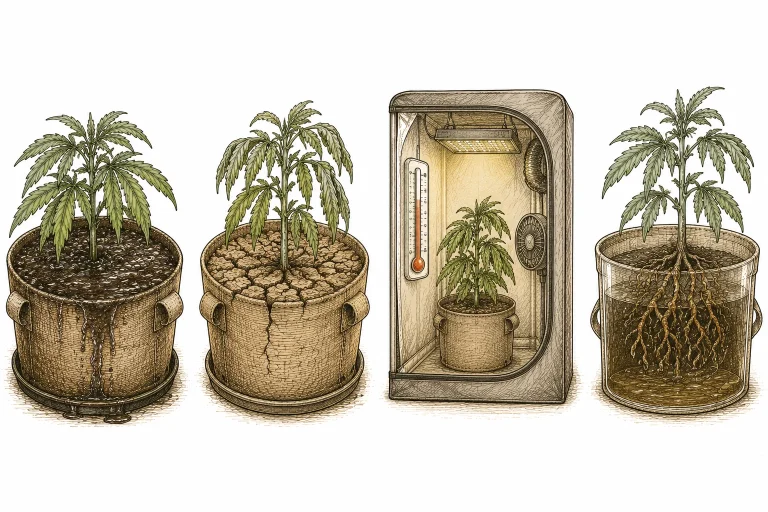
Statistically, overwatering is the number-one cause of wilting cannabis plants, especially for beginners. Many growers think more water means more growth, but it’s the other way around. When the soil is constantly too wet, water pushes the oxygen out of the pores in the growing medium. The roots literally start to suffocate, can’t take up nutrients anymore, and the plant collapses. If you want to learn how to water cannabis the right way, get to know the finger test: stick your finger about 1–1.5 in (3–4 cm) deep into the soil. If it’s still moist down there, don’t water.
Underwatering is the opposite problem and tends to show up in the peak of summer or under strong grow lights. If the pot is too small for the size of the plant, or the growing medium has turned hydrophobic (meaning it repels water instead of soaking it up), the plant can’t take in enough water even when you water it. What helps here is slow, thorough watering or briefly soaking the whole pot in water.
Heat stress kicks in when the temperature in your grow tent climbs above 82–86 °F (28–30 °C) or the light is hung too close to the plants. Plants under heat stress close their stomata, the tiny pores in the leaves, to save water. That shuts down photosynthesis and the leaves wilt. LED and HPS lights in particular can cause serious heat stress when the distance isn’t right. Check the temperature regularly at canopy height, not just down at floor level.
Root problems are the most serious cause, because they often point to several mistakes happening at once. Root rot (pythium) develops in constantly wet, low-oxygen conditions, and you can spot it by brown, slimy roots. Pots that are too small, where the roots have run out of space (rootbound), can also lead to wilting because nutrient uptake breaks down. Root aphids can damage the root system directly, and their feeding can trigger wilting even when there’s no watering problem at all.
- Overwatering: the most common cause. The growing medium stays wet and the roots run out of oxygen.
- Underwatering: the pot feels too light, the medium is dry, and too much time passes between waterings.
- Heat stress: temps above 82–86 °F (28–30 °C), a light that’s too close, or poor ventilation.
- Root rot (pythium): brown roots and a musty smell. This isn’t a watering problem.
- Rootbound: the roots fill the whole pot and there’s no room left to grow.
- Nutrient deficiency: can cause wilting as a side effect when uptake is blocked.
- Light burn: light that’s too intense, hitting the leaves directly.
Emergency fixes: how to stabilize a wilting cannabis plant fast
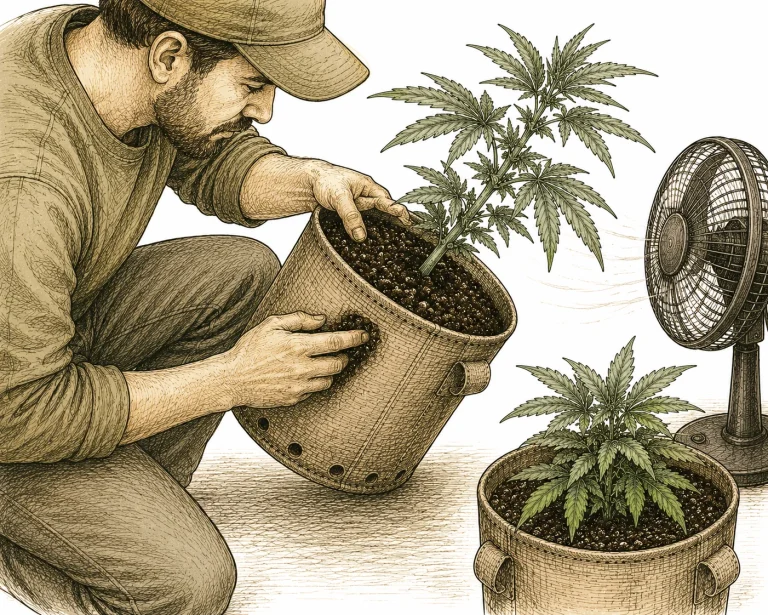
If your cannabis plant is wilting, rule number one: stay calm and work through it step by step. Check the obvious causes first before you move on to the next fix. Lift the pot. Is it heavy? Then overwatering is likely. Is it light as a feather? Then water right away. This simple test can save you from a lot of mistakes.
If you’ve overwatered: stop watering. Instead, help the pot dry out by moving it to a well-ventilated spot and, if needed, pointing a fan at the soil surface. If you can, gently poke a few holes along the sides of the medium with a stick to get some oxygen in. Wait until the pot feels noticeably lighter before you water again. In the worst case, your only option may be repotting into fresh, airy growing medium.
If you’ve underwatered: water slowly and thoroughly until water runs out of the drainage holes. If the medium has turned hydrophobic (water beads up or runs straight down the edges), set the pot in a tub of water for 15–30 minutes so the medium soaks it up evenly. Within 30 to 60 minutes, the leaves should perk back up.
If it’s heat stress: bring the temperature down right away by raising the light or boosting ventilation. Open the grow tent for a bit or switch on an extra fan. Make sure the room around your grow tent isn’t too hot either. An air conditioner or evaporative cooler may be necessary here. For outdoor plants, shade cloth can help cut direct sunlight during heat waves.
If you suspect root rot: take the plant out of the pot and inspect the roots. Healthy roots are white to creamy white. Brown, mushy or foul-smelling roots are a sign of root rot. Cut off affected roots with sterile scissors, treat the remaining roots with a trichoderma-based biological fungicide or diluted hydrogen peroxide (3 %, heavily diluted), and repot into fresh, dry growing medium.
- Step 1: Lift the pot and check the weight (heavy = overwatering, light = underwatering)
- Step 2: Check the temperature and the distance to your light
- Step 3: Stop watering or water thoroughly right away, depending on what you find
- Step 4: Max out ventilation and remove the source of stress
- Step 5: If you suspect root problems, unpot the plant and inspect the roots
Nutrient deficiency as a cause of wilting cannabis plants
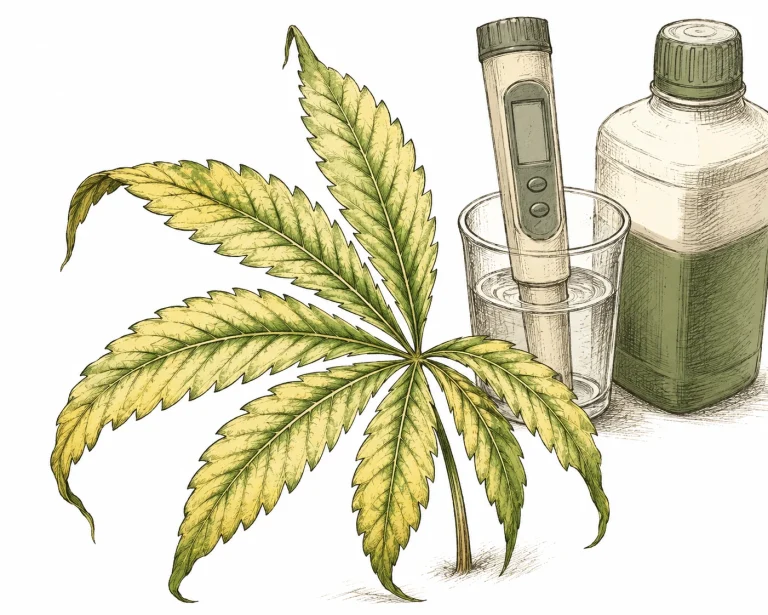
Water or temperature aren’t always to blame. A severe calcium deficiency in cannabis can also cause wilting, because calcium plays a structural role in the cell walls. Without enough calcium, the cells lose their stability and the leaves go limp. On the flip side, nutrients like nitrogen, phosphorus or magnesium can cause nutrient toxicity when you feed too much of them, and that can disrupt water transport inside the plant.
A link that often gets missed: the wrong pH blocks nutrient uptake, even when every nutrient is present in the solution. In soil, your pH should sit between 6.0 and 7.0. In coco coir, aim for 5.5 to 6.5. If the pH drifts outside these ranges, the plant can’t take up nutrients, develops an induced deficiency and starts to wilt. So always check your cannabis pH before you start feeding.
If you suspect overfeeding is behind the wilting, the easiest fix is a thorough flush (flushing) of the growing medium with pH-adjusted water. This washes out excess nutrient salts. You can learn more about how to spot and fix nutrient burn in cannabis in our in-depth article. After flushing, wait until the medium is almost dry before you start feeding again at a reduced dose.
- Calcium deficiency weakens cell walls → leads to wilting and brown spots
- pH outside the ideal range → nutrient uptake gets blocked
- Overfeeding raises your EC (electrical conductivity) → osmotic stress, so the plant can’t take up water
- Nitrogen toxicity → dark leaves, weak structure, possible wilting
- After flushing: always check your pH before you feed again
Save Wilting Cannabis Plants by Repotting the Right Way
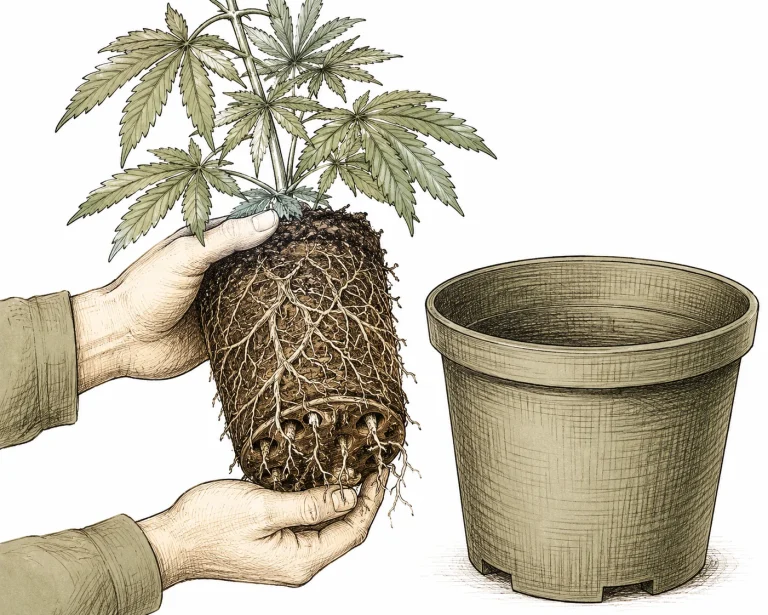
If roots are poking out of the bottom of the pot, pressing visibly against the sides, or your growing medium barely soaks up water anymore, your plant is rootbound – the roots have run out of room. In this state, water and nutrients can’t move through the plant efficiently, and it can wilt even when you’re doing everything else right. The fix is simple: repot into a bigger container.
Rule of thumb: during the vegetative stage, moving up a pot size every 2–3 weeks makes sense. Start with about 0.25 gal (1 L) for seedlings, go to 1 gal (3–5 L) for young plants, and end up at 3–7 gal (11–25 L) for mature plants in the flowering stage. When you repot, try not to disturb the roots more than you need to. Water the old pot lightly so the root ball slides out in one piece, then set the plant into the new pot without damaging it.
Fresh, loose growing medium gives the roots instant oxygen and room to grow. Your plant should perk up noticeably within 24 to 48 hours. Keep in mind that the new medium may already contain base nutrients – so after repotting, wait about a week and then feed at reduced strength to avoid cannabis nutrient burn.
- Roots growing out of the drainage holes → repot right away
- Water runs straight through without soaking in → compacted medium or rootbound
- Give the plant 24–48 hours of rest after repotting
- New medium contains base nutrients → don’t feed for one week
- Ideal pot sizes: 0.25 gal (1 L) → 1 gal (3 L) → 2 gal (7 L) → 3–7 gal (11–25 L), depending on the growth stage
Prevention: How to Keep Your Cannabis Plants from Wilting for Good
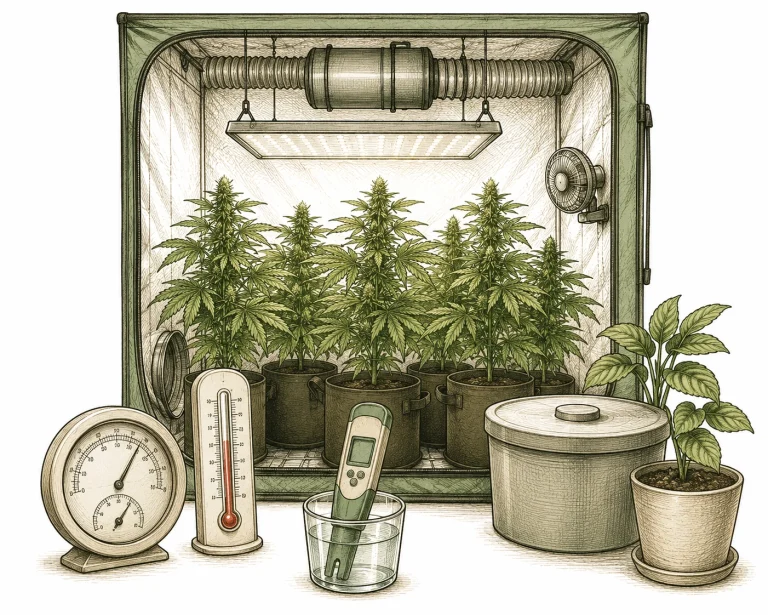
The best treatment is the one you never need. A few simple routines can prevent wilting cannabis plants almost completely. The most important one is a structured watering routine: only water when the pot feels noticeably lighter and the top 1–1.5 in (3–4 cm) of growing medium is dry. Keep a watering log so you can spot patterns and act on data instead of gut feeling.
Keep a close eye on temperature and humidity with a digital hygrometer-thermometer that stores min and max readings. The ideal temperature sits between 68 and 82 °F (20–28 °C), depending on the growth stage – toward the lower end during flowering. Good ventilation with the right exhaust and intake keeps air moving and helps stabilize the temperature. In some situations, a dehumidifier can also help keep conditions in your grow tent steady.
Check your pH every time you water or feed. A wrong pH is the most common hidden trigger for wilting that seems to come out of nowhere. Calibrate your pH meter regularly and keep buffer solutions on hand. If you start running into cannabis yellow leaves and other deficiency symptoms, you’ll often find the same root cause there: a pH problem that led to wilting over time.
Use pots that are big enough, with good drainage and a loose, airy growing medium. Fabric pots are an excellent choice: thanks to air pruning, they promote a healthy root system, and their passive airflow makes overwatering much harder. They also boost oxygen availability at the roots. If you want to set up your whole grow the right way from the start, the cannabis indoor grow guide sums up all the basics in one place.
- Watering routine: use the finger test or pot weight to decide when to water
- Check the temperature daily and use a min/max thermometer
- Measure and log your pH every time you water
- Use fabric pots for better root aeration and protection against overwatering
- Match pot size to plant size and actively prevent rootbound plants
- Keep a watering log: note the date, amount, pot weight and observations
The Bavarian Garden Academy (Bayerische Gartenakademie) also confirms that irregular or too-infrequent watering is one of the main causes of wilting, droopy plants: their golden rule against drought stress is to water less often, but thoroughly.
Wilting often starts at the roots: lack of oxygen at the roots (German) and root-bound plants (German) are two of the most common triggers. If the leaves are just droopy rather than fully wilted, check out our article on drooping leaves (German). If your plant has basically stopped growing, take a look at stunted growth (German). Unusually thin stems (German) or curling leaves (German) can point to the same causes.
Frequently Asked Questions
Why is my cannabis plant wilting even though I just watered it?
If your plant wilts right after watering, the problem is usually at the roots. Possible causes include root rot from constant overwatering, a root-bound plant (the roots have run out of room), a pH that is way off and blocks nutrient uptake, or pests attacking the roots. Gently take the plant out of its pot and inspect the roots. White roots are healthy. Brown, mushy roots are a sign of rot.
How long does it take a wilted cannabis plant to recover?
That depends on the cause and how severe it is. If the plant was simply thirsty, it usually perks up within 30–60 minutes after watering. After overwatering or heat stress, recovery can take 24–72 hours. Once you repot a root-bound plant, you should see clear improvement within 2–3 days. Severe root rot or long-lasting heavy stress can take one to two weeks to recover from.
Can a cannabis plant fully recover from severe wilting?
Yes, in most cases, as long as you act in time. Even plants with heavy root rot can often be saved if enough healthy root tissue is left. Cut away the affected roots, disinfect the remaining ones and repot into fresh growing medium. Fast diagnosis is key: the longer the stress lasts, the harder the recovery. If you step in early, you can almost always keep the plant from dying.
Is slight wilting in the evening normal for cannabis?
Leaves that relax a little toward the end of the light cycle are normal for many cannabis plants and nothing to worry about. It comes from the plant’s natural daily rhythm and the fading light later in the day. It becomes a problem if the plant still hangs limp after hours in the dark or during the light cycle. Watch for the pattern: if your plant fully bounces back in the morning after the lights come on, everything is fine.
What pot size prevents root-bound plants and wilting?
A rough rule of thumb: about 0.25 gal (1 L) of pot volume for every 12 in (30 cm) of plant height. A fully grown indoor plant in flowering should have at least 3–4 gal (11–15 L), larger strains 5–7 gal (20–25 L). Fabric pots in these sizes give you the best mix of drainage, airflow and root health. Check about every two weeks whether roots are growing out of the drainage holes. That is the most reliable sign that it is time to repot.
Do mycorrhizal fungi help with wilting cannabis plants?
Mycorrhizal fungi can help indirectly by expanding the root surface area and improving water uptake. They work best as prevention, when you apply them right to the roots at transplant. If your plant is already wilting from root rot, fix the acute problem first. Then add mycorrhizae when you repot to give the fresh growing medium a head start. Keep in mind: mycorrhizae don’t tolerate synthetic fungicides and can be weakened by overfeeding.
The Bottom Line
Saving a wilting cannabis plant is possible in the vast majority of cases – as long as you spot the cause quickly and take targeted action. The most common triggers are overwatering or underwatering, heat stress and root problems, and you can diagnose and fix all of them with simple steps. A consistent watering routine, regular pH checks and big enough pots are the three main pillars of prevention. Use the Plant Diagnosis overview on PlantClue to catch future problems even earlier and keep your plants healthy for the long haul. If the leaves are drooping slightly rather than fully wilting, our article on drooping cannabis leaves will help you out.
