

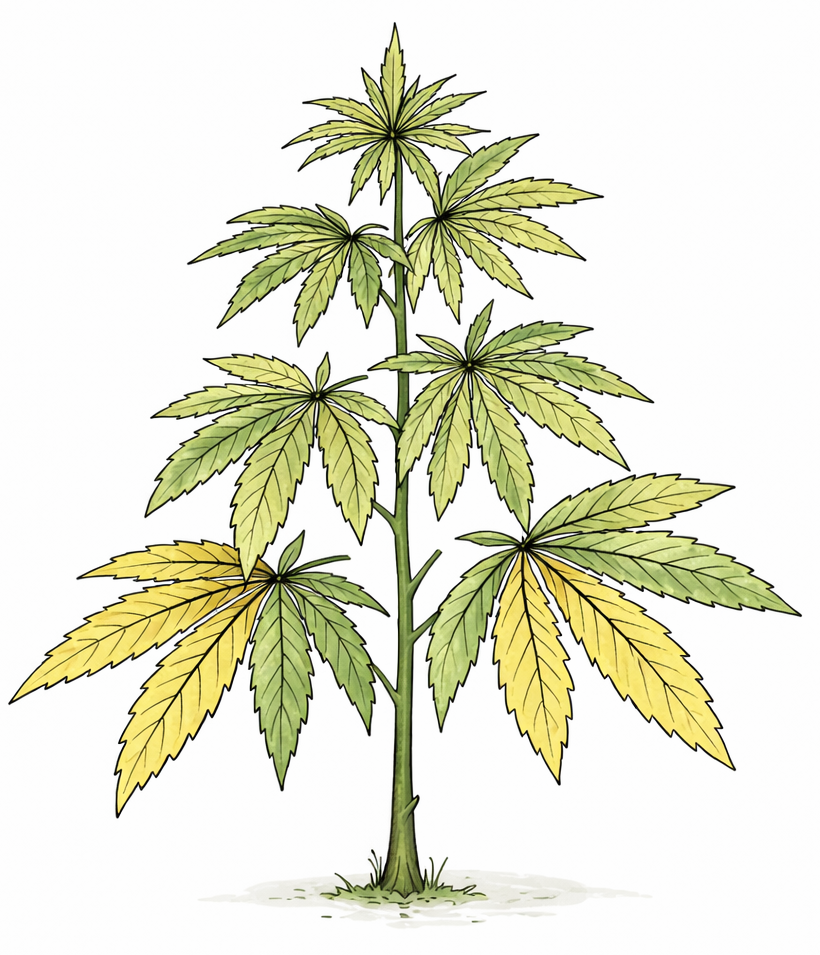
When cannabis leaves turn yellow, it’s usually a warning sign that something is out of balance. Most growers run into this problem sooner or later and aren’t sure what’s causing it.
Whether you call it cannabis, weed, marijuana or hemp, the plant shows exactly the same symptoms with this problem — the causes and fixes below apply no matter which name you use.
Yellow cannabis leaves can have many causes — from nutrient deficiencies to poor watering habits. Often the exact cause isn’t obvious right away.
Especially with indoor growing, mistakes with light, water or nutrients can quickly lead to problems. You’ll find a detailed walkthrough in our guide to growing cannabis indoors.
Why do cannabis leaves turn yellow?
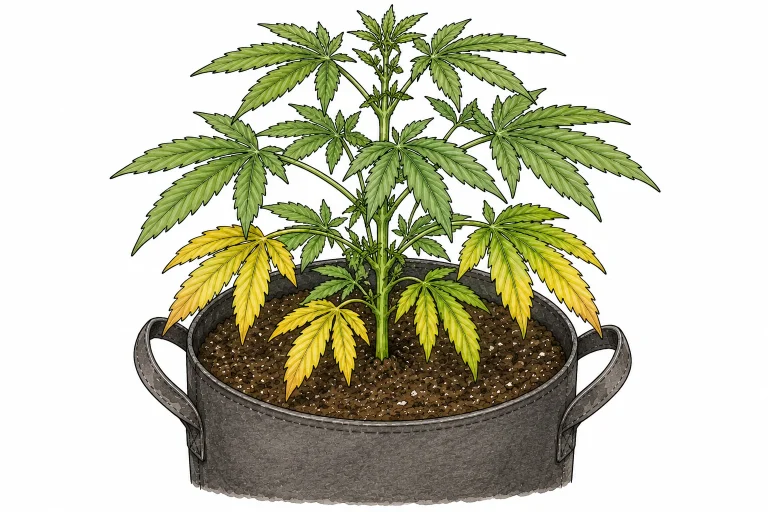
Yellow cannabis leaves are usually caused by an imbalance in nutrients, water or pH. Common causes are nutrient deficiencies, overwatering, underwatering or disrupted nutrient uptake.
Often it’s a combination of several factors that leads to yellow leaves. That’s why it’s important to pin down the exact cause before you take action.
The most common causes at a glance
The most common reasons for yellow cannabis leaves are nutrient deficiencies, overwatering, underwatering and problems with pH. Light stress, pests and diseases are also common triggers, and each of these causes looks a little different and should be checked specifically.
Below, we walk through the most important causes in detail.
Nutrient deficiency as the cause
A common reason for yellow cannabis leaves is a lack of nutrients, especially nitrogen. The plant then starts pulling nutrients out of its older leaves, which makes them turn yellow.
If the lower leaves are affected first, that often points to a nitrogen deficiency. These symptoms are well known in many other plants too — according to the Bavarian State Institute for Viticulture and Horticulture (LWG), nutrient deficiencies often lead to discoloration and growth problems.
If you suspect a nutrient problem, our cannabis nutrient deficiency chart helps you narrow down the exact deficiency — or check out our guide to calcium deficiency for one specific set of symptoms.
Spotting magnesium and iron deficiency
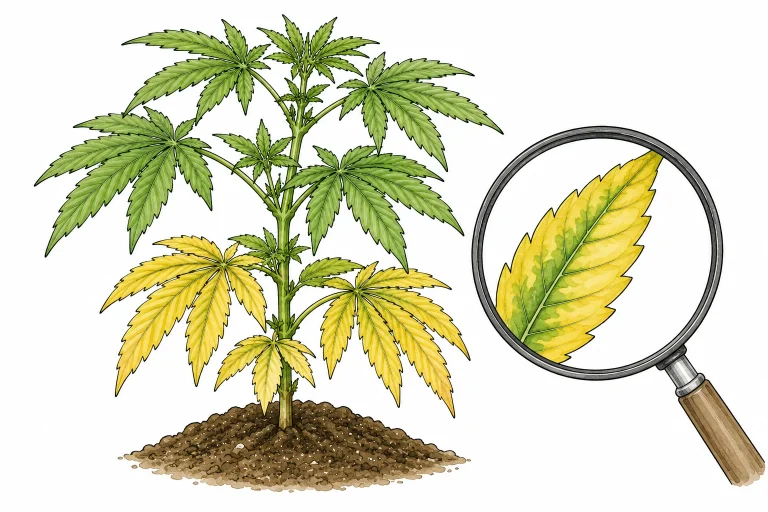
Yellow cannabis leaves don’t always look the same — and that’s exactly what helps you with the diagnosis. While nitrogen deficiency turns the leaves evenly and completely yellow, magnesium or iron deficiency shows a different pattern: the leaf veins stay green while the tissue between them turns yellow. Experts call this interveinal chlorosis.
Magnesium deficiency usually hits the older, lower leaves first, because the plant pulls the nutrient out of them when it needs it. Iron deficiency, on the other hand, often shows up first on the young, upper leaves, because iron barely moves within the plant.
Both deficiencies are often linked to pH: if it’s outside the optimal range, the plant has a harder time taking up magnesium and iron, even when there’s plenty of both in the growing medium. So a quick look at the discoloration pattern — completely yellow or only between the veins — narrows down the cause a lot before you reach for the nutrients.
Spotting overwatering
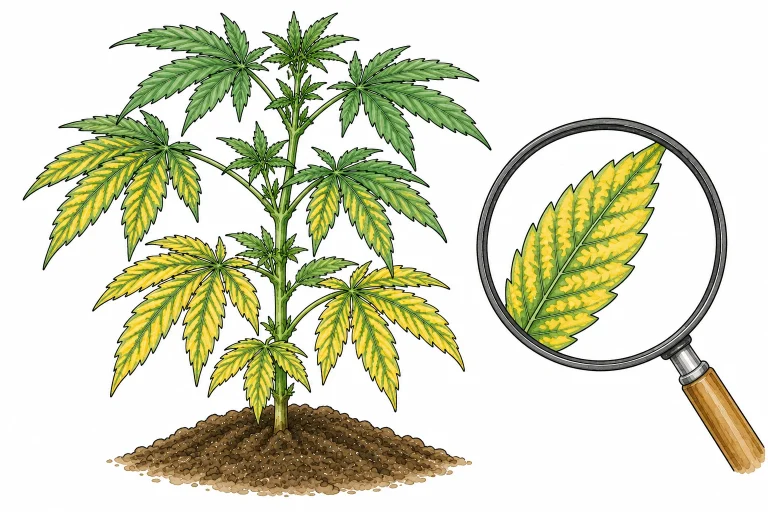
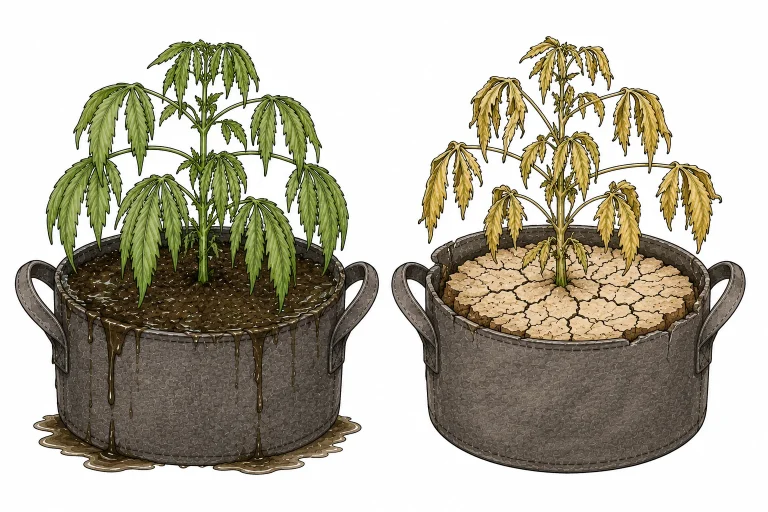
Too much water can keep the roots from getting enough oxygen. This disrupts nutrient uptake, and the leaves turn yellow.
Other typical signs of overwatering are drooping leaves and soil that stays wet all the time.
Another typical sign of overwatering is leaves that look soft and feel heavy. The soil often stays damp or even soaking wet for several days.
Many growers water too often because they think the plant needs water constantly. In reality, the roots need oxygen too. If the plant sits in water all the time, the roots can “suffocate,” which seriously hurts nutrient uptake.
A good rule of thumb is to water only once the top layer of soil has clearly dried out. The pot should feel noticeably lighter than right after watering.
Overwatering is one of the most common causes of yellow cannabis leaves. According to the LWG Bavaria, a growing medium that stays too wet for too long leads to a lack of oxygen in the root zone and blocks nutrient uptake. What you can do about it is explained in our guide to overwatering.
Spotting underwatering
Too little water can also cause yellow cannabis leaves. In this case the plant dries out and can no longer take up important nutrients.
The leaves often look dry and brittle and droop as well.
With underwatering, the leaves often feel dry and thin. The soil pulls away from the edge of the pot and looks very loose and dusty.
A typical mistake is watering only the surface. The water then never really reaches the roots. What matters is watering evenly until a little water runs out of the bottom of the pot. For how to water cannabis the right way, see our guide to proper watering.
If the plant regularly gets too little water, growth can slow down a lot. The plant then focuses on survival instead of putting out new leaves and shoots.
pH problems
pH plays a key role in nutrient uptake. If the pH is too high or too low, the plant can’t take up certain nutrients, even though they’re present in the soil.
This often leads to yellow leaves even though there are actually enough nutrients available.
Ad / affiliate link: Instead of guessing, an 8-in-1 soil tester can help: it measures pH, EC, nutrient levels and moisture at the same time and analyzes the readings in an app — so you can see at a glance whether pH or nutrients are behind the yellow leaves. You can find it here on Amazon. *As an Amazon Associate, we earn from qualifying purchases.
Light stress as the cause
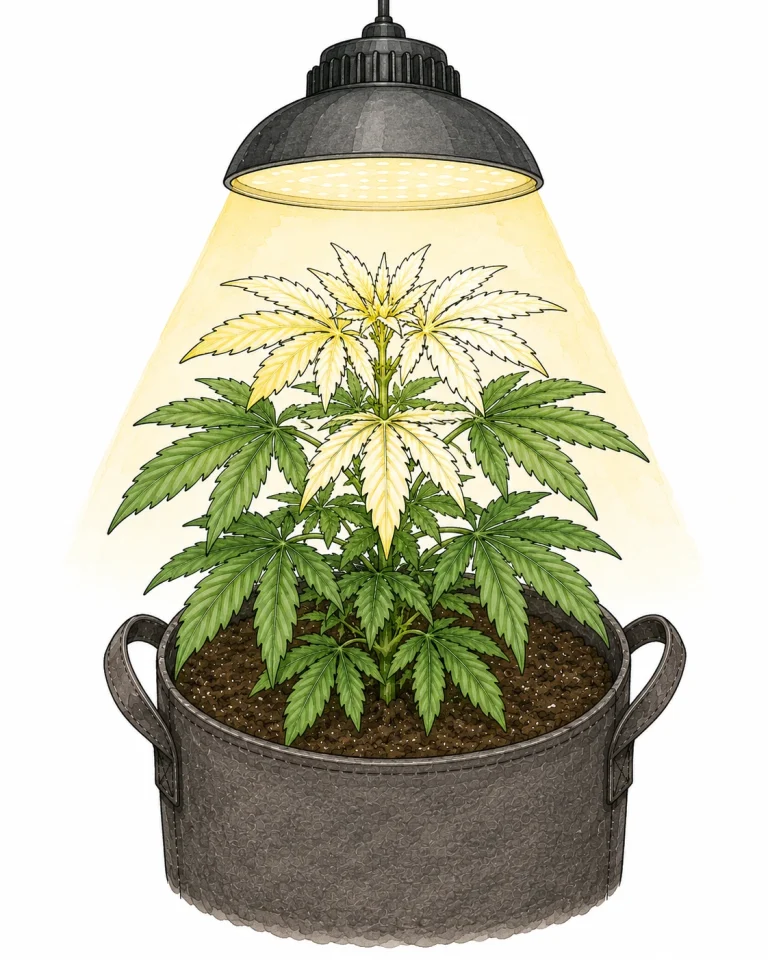
Especially in indoor growing, light stress is often overlooked when it comes to yellow cannabis leaves. If the plant is too close to a powerful lamp or the light period is too long, the leaf tissue can literally bleach out.
Unlike nutrient problems, light stress usually starts at the topmost leaves — right where the plant is closest to the light source. The affected areas often look pale yellow to whitish instead of yellowing evenly or in a pattern.
To avoid this, check the distance between the light and the top of the canopy, as well as the recommended wattage for each growth stage. Just a few inches of distance can make the difference between top leaves that stay healthy and green and top leaves that suffer from light burn.
Temperature stress as a cause
Temperatures that are too high or too low are, next to light, among the most common stress factors that can turn cannabis leaves yellow. If the temperature stays above 86 °F (30 °C), the plant can no longer take up nutrients properly, even though there is enough in the growing medium – the leaves then turn yellow despite correct feeding.
Ambient temperatures that are too cold, for example below 59 °F (15 °C) at night, also slow down root metabolism and can cause deficiency symptoms similar to disrupted nutrient uptake. A typical sign of temperature stress is that the yellowing usually shows up in several places on the plant at once, instead of spreading from the bottom up like a nutrient deficiency.
You’ll find detailed symptoms and fixes in our article on heat stress in cannabis. If in doubt, check the room temperature at leaf level first, before you change your nutrients or pH.
What you should do right now
If your cannabis shows yellow leaves, check the soil, your watering habits, your feeding and the pH first. Only when you narrow down the cause correctly can you fix the problem in a targeted way.
If the soil is wet all the time, overwatering may be the cause. If it’s very dry, the plant is short on water. If you also see fuzzy gray patches on the buds or a white coating on the leaves, a fungal disease could also be behind the symptoms.
Next, you should check your feeding. Too little or too many nutrients can also lead to yellow leaves. Make sure you use the right amount and the right nutrients.
Another important point is pH. If it’s outside the optimal range, the plant can’t take up nutrients properly, even when there are enough of them.
When does it become serious?
It becomes serious when the yellow leaves spread quickly or new leaves are affected too. If the problem goes untreated, growth can suffer significantly.
If the leaves look more light green than truly yellow, read our article on light green leaves. If you also see white spots, there may be a different cause — read more about white spots on leaves.
Cannabis leaves falling off: normal or a warning sign?
Not every falling leaf is a problem — cannabis naturally drops individual leaves over the course of its life cycle. What matters is when and how many leaves drop.
This is normal
- Lower, older leaves drop in late flowering — the plant pulls nutrients back and focuses on the buds.
- A few shaded inner leaves in a dense canopy turn yellow and drop because light no longer reaches them.
This is a warning sign
If lots of leaves drop at the same time, if upper or young leaves are affected, or if it already happens in the vegetative stage, there’s usually a cause behind it: nitrogen deficiency, overwatering or underwatering, often first noticeable as drooping leaves, root rot, pests like spider mites or whiteflies, as well as cold stress and heat stress or light burn.
Quick check in 3 questions
- Where do the leaves drop first — at the bottom (usually normal) or at the top and all over (warning sign)?
- What stage is the plant in — late flowering (more likely normal) or the vegetative stage (more likely a warning sign)?
- Were the leaves yellow, spotted or wilted beforehand? That points you to the matching cause above.
FAQ: yellow leaves on cannabis plants
Are yellow cannabis leaves always a problem?
Yellow cannabis leaves aren’t always a problem. In late growth stages, it can be normal for older leaves to turn yellow while the young leaves stay healthy.
It does become a problem, though, when young leaves are affected or the discoloration spreads quickly. In that case, you should find the cause fast and take action.
Can pests or diseases cause yellow leaves?
Yes. Besides nutrient deficiencies and incorrect watering, spider mites or fungal diseases, as described in our guide to cannabis diseases, can also cause yellow leaves.
So check the undersides of the leaves for pests and look for other signs such as spots or fine webbing before you assume the cause is only nutrients or water.
Common mistakes with yellow leaves
A common mistake is to immediately add more nutrients as soon as the leaves turn yellow. In many cases that makes things worse, especially when the cause is overwatering or the wrong pH.
Changing several factors at once can also be a problem. If you change your watering, nutrients and plant location all at the same time, it becomes hard to tell what actually helped.
So always go step by step and watch closely how your plant responds.
Not every leaf discoloration is yellow: if the yellowing shows up specifically during flowering, read our article on yellow leaves during flowering. Leaves curling into claws or tacos point more toward leaf claw, brown edges toward brown leaf tips, and you’ll find spot-like discoloration covered in our article on spotted leaves.
Conclusion
Yellow cannabis leaves are a common problem that can be solved in most cases. What matters is spotting the cause correctly and acting in a targeted way.
With a bit of experience, you’ll quickly learn to read the signs correctly. That way you can catch problems early and keep your plants healthy.
